

Cart
0
INDIELIXIRS® JOURNAL · ARTICLE 07108 moments
108 moments
of return.
Chandan. Crystal. A bead at a time.
ENTER THE STORY ↓✳A STRAND WITH A PURPOSE
108 Moments of Return: Chandan, Crystal and the Japa Mala
The INDIELIXIRS® Journal · Ritual Objects · Article 07
A mala is understood first by the hand. One bead is held, a word or a breath is given its time, and the fingers move to the next. The movement is small enough to disappear from across a room. For the person holding it, it may become the centre of the moment.
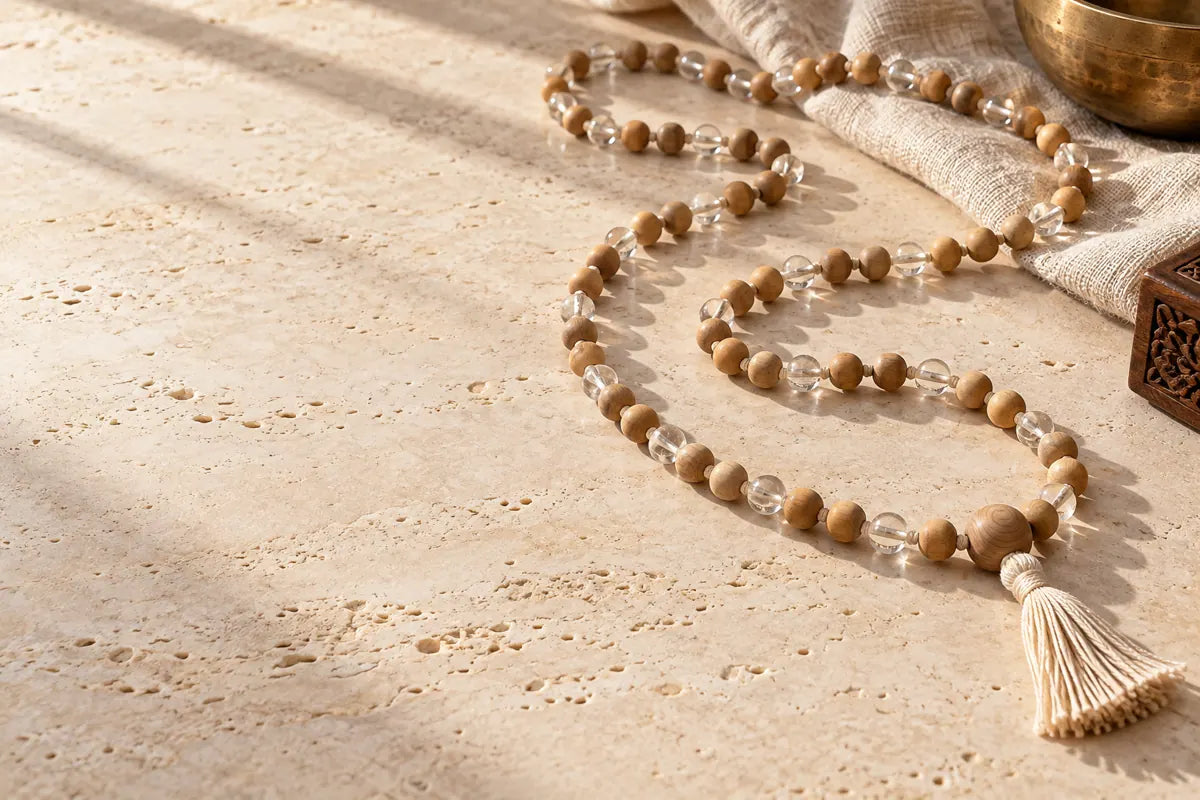
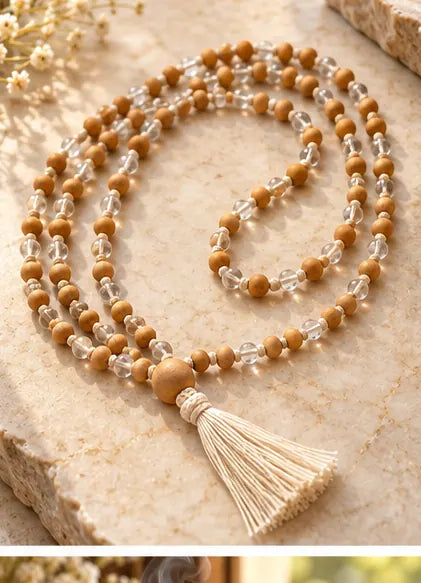
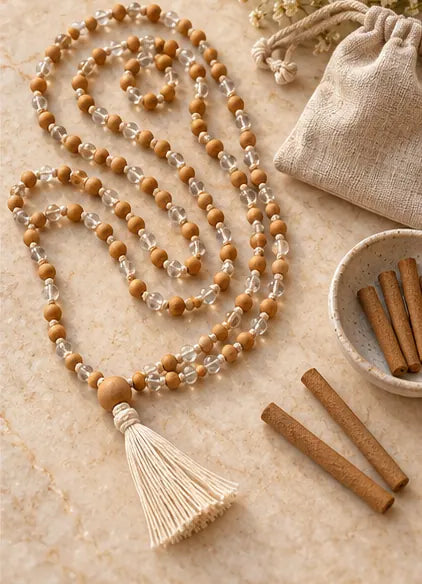
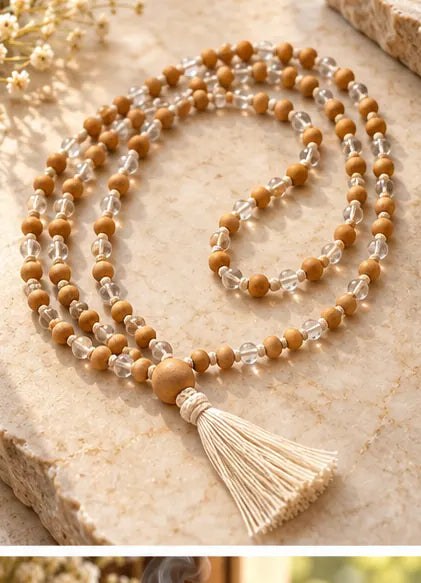
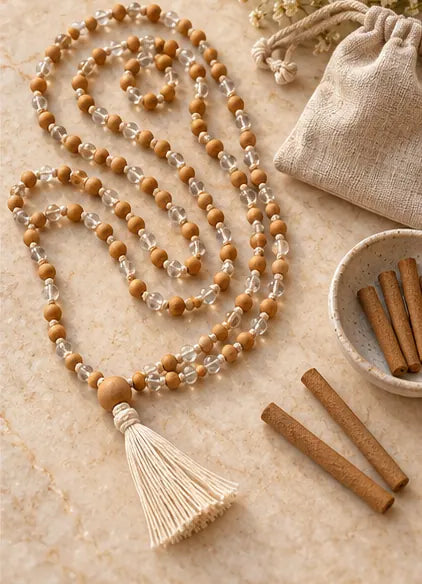
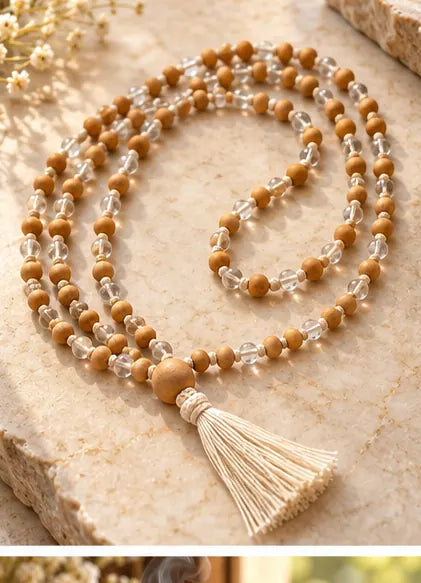
The INDIELIXIRS® Chandan Crystal Japa Mala brings together 108 counting beads, one additional meru bead, and ganthan: individual knots that give the strand its pace. Warm wooden beads meet clear crystal. Near the junction, the meru marks where one round finishes and another can begin. Beside the practice, INDIELIXIRS® Sandalwood Dhoop Sticks bring fragrance into the room. The mala remains in your hands; the scent becomes part of the setting.
This is an object with a living context. We can admire the wood, light and craftsmanship, but we should also understand why a japa mala has a count, a turning point and space between its beads.
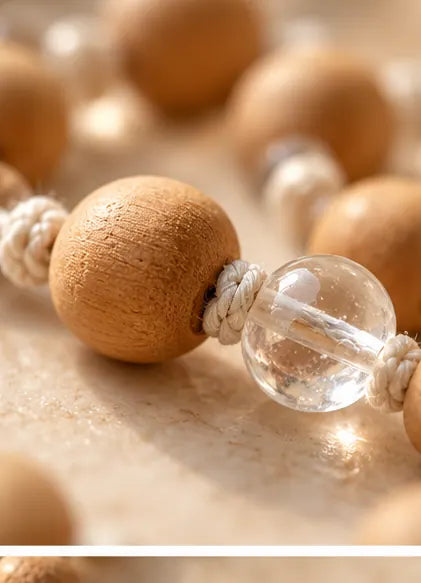
A strand made for repetition
Japa refers to the repeated recitation of a mantra or divine name, aloud, softly or inwardly, according to a person’s tradition. Hindu teaching resources describe the mala as a way of counting the repetitions, commonly with 108 beads. One repetition accompanies one bead. [1][2]
A bracelet can be noticed in passing. A full japa mala asks to be held. Its length settles into the hands or lap; a bead travels through the fingers, and then another. The count gives shape to an act that might otherwise be hard to hold in a busy mind. You need not stare at a clock or ask how long you have been sitting. The next bead is there.
The 108 counting beads in this INDIELIXIRS® mala are the beads a user moves through in one complete round. The meru is an additional marker, not bead number 109 in the count. Different lineages have their own ways of handling a mala; we would follow the practice taught by one’s family, teacher or tradition. In a common method described by the Himalayan Institute, a practitioner turns the mala around at the meru instead of crossing over it to begin another round. [3]
The important thing is not to invent one universal rule. It is to see how the physical design helps a person know where they are.
THE STRUCTURE, AT A GLANCEA circle with
A circle with
a turning point.
108
counting beads
One bead at a time through a complete round.
+1
meru bead
A distinct marker where the round ends and may turn.
↝
ganthan
Hand-tied knots that give the strand its tactile rhythm.
108: a count you can feel
The number 108 has accumulated many explanations across spiritual traditions. Some are devotional, some symbolic and some more recent attempts to find a perfect mathematical story. We do not need to claim that every explanation originated in the same scripture or that every practitioner holds the same view.
What can be said simply is that 108 beads make a full count in many japa practices. Hindu sources from different traditions describe repetition bead by bead. The practice may be a divine name, a mantra received from a teacher, or another form of recitation that belongs to one’s own path. [1][2]
A full round can become familiar without becoming automatic. Sometimes the first few beads are restless. Sometimes the mind travels elsewhere and needs to be brought back without anger. The strand offers no criticism. It simply offers the next bead.
For someone approaching the mala outside a formal tradition, it may be used for a quiet reflection or as a way of pacing breaths, while recognising that this personal use is different from a lineage’s japa instructions. The same object can be held with respect without claiming a ritual initiation it has not received.
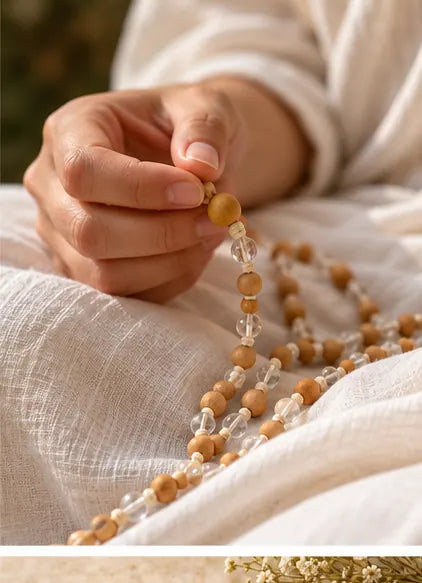
The meru: a place to turn
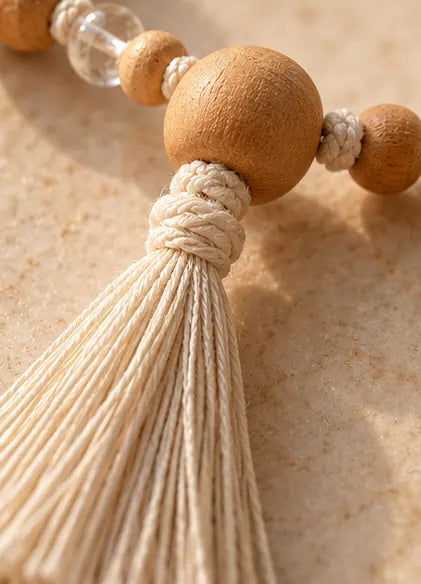
The meru, also called the guru bead in some traditions, stands apart from the 108 counting beads. Its size and place at the junction make it easy to recognise through touch. The Himalayan Institute describes this bead as the point where the direction of counting changes for another round. [3]
Look at what that means in the hand. After a long circle of repetition, you arrive somewhere recognisable. You pause, and if you wish to continue, you turn. A beginning and an ending meet in one bead.
It is tempting to make every feature of a mala into a guaranteed spiritual result. The meru needs no such promise. Its function is elegant and useful: it gives the circle a landmark. For a devotee, the landmark may carry a deeper meaning learned from a teacher. For an admirer of thoughtful objects, it is a piece of design that makes a practice legible to the fingers.
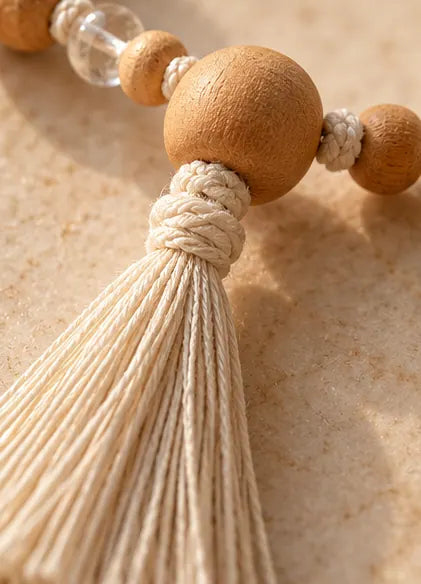
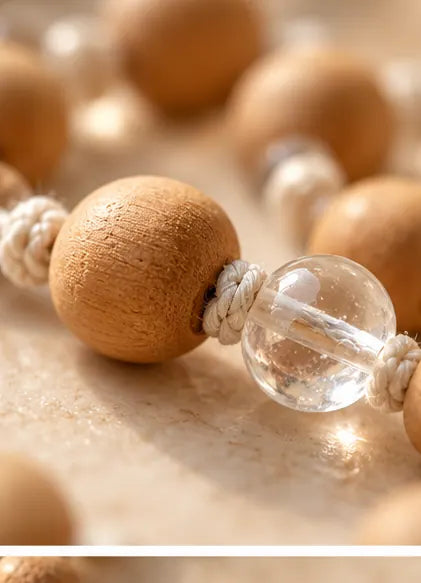
Ganthan: the spaces between
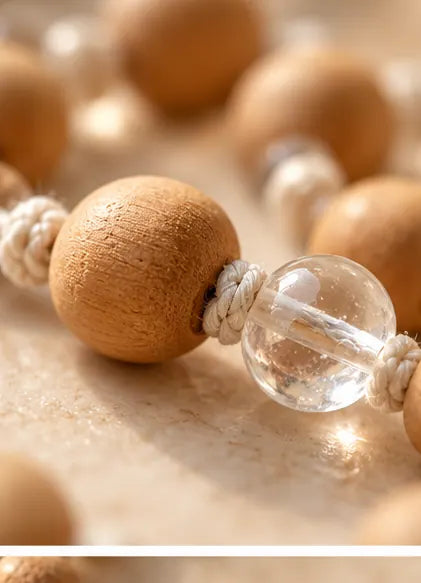
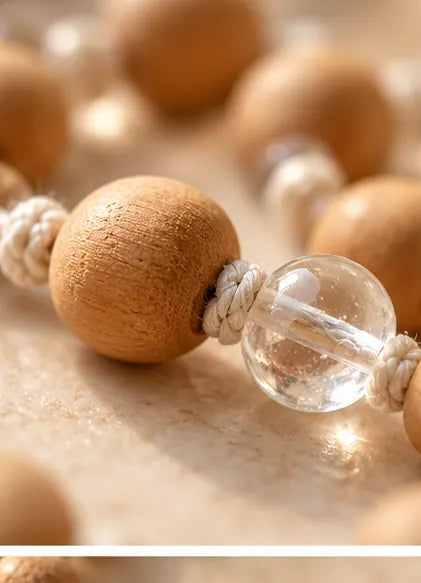
Ganthan gives this mala its measured feel. A hand-tied knot separates neighbouring beads along the strand. Instead of one unbroken slide, the hand encounters bead, knot, bead. The knots provide room for the fingers to find each bead and help keep polished surfaces from sitting hard against one another. The Himalayan Institute describes knotted malas with space between the counting beads and a more elaborate junction near the meru. [3]
This detail deserves a close look. From a distance, ganthan may almost disappear. In use, it is present at every step. It can make the motion feel deliberate without requiring someone to move slowly on command.
The knots also make the object visibly made. A strand is not only a row of stones and wood; it is thread, tension, repeated handwork and the decision to leave a little space. That quiet workmanship is part of its beauty.
THE RHYTHM OF THE STRANDBead. Knot.
Bead.
Bead.
Enough space to return to the next repetition.
Chandan and crystal: warmth beside light
A wooden bead holds light across its grain. A clear crystal bead receives and refracts it. Together they make a gentle exchange of opacity and transparency, touch and gleam. Colourless transparent quartz is often called rock crystal in gemology. [4]
The word chandan has a much wider cultural life than an individual bead. In India, sandalwood paste appears in living devotional settings: Sri Sringeri Sharada Peetham describes the image of Sri Janardana as covered with sandal paste. [5] Paste on an image, incense in a room and polished wood on a mala are different uses of a fragrant material. The example helps locate chandan within a tradition without making an unwarranted claim that a contemporary product is temple-blessed or made from a particular botanical species.
The clear beads do not need to be described as “amplifying” the wooden ones. Their contrast is visible and tactile enough. A person may find a personal symbolism in it: warmth and openness, memory and possibility, stillness and light. That is a reading you may choose, not a rule everyone must accept.
AN INDIELIXIRS® CREATIONThe scent
The scent
of sandalwood.
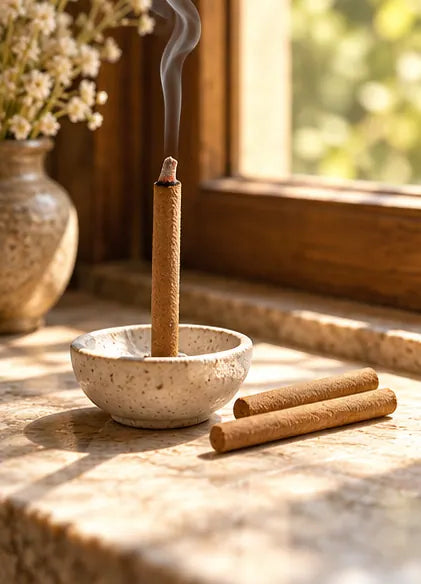
INDIELIXIRS® Sandalwood Dhoop Sticks bring fragrance to the space around the mala.
A fragrance in the room: sandalwood dhoop
The mala belongs in the hand. INDIELIXIRS® Sandalwood Dhoop Sticks bring their own presence to the space around a moment of japa, prayer or quiet reflection. The pairing is sensory: warm wood and clear crystal in the hands, sandalwood fragrance in the air. Some will choose the scent; others will prefer the room exactly as it is.
Sandalwood’s place in aromatic practice has travelled through different histories. Kyoto National Museum describes how incense entered Japanese practice alongside Buddhism and how fragrant woods later became the focus of highly considered aesthetic customs. [6] That Japanese history is distinct from Indian household dhoop; we mention it because it shows another way people have made room for scent, attention and craft.
A simple arrangement is enough: light an INDIELIXIRS® Sandalwood Dhoop Stick according to its instructions and allow its fragrance to settle into the room before taking up the mala. Use a stable, heatproof surface and a little fresh air; the U.S. Environmental Protection Agency recommends ventilation when incense is burned indoors. [7] Keep flame and ash away from the mala and fabric, and extinguish the stick before leaving the room. The wood and cord of the mala should stay clean and dry.
You might set the dhoop before sitting down, notice the fragrance, and then take the mala into your hands. The scent gives the room a character. The beads give the hands a path. Each can be appreciated on its own.
How a round might unfold
Settle somewhere comfortable. If you follow a mantra practice, begin in the way you have been taught. Locate the bead beside the meru. Move through the 108 counting beads, allowing one repetition for each bead. When the meru comes around again, stop there. If another round is part of your practice, turn the mala and continue in the reverse direction, following your tradition’s method. [1][3]
If the mala is simply a personal object for reflection, a gentler version might be to hold a few beads, pause at each one and name an intention or notice a breath. There is no need to borrow a sacred mantra as decoration or perform a ceremony you do not know. The physical act of moving from bead to bead can still be meaningful because you choose to give it attention.
The number can be completed. Or you may stop earlier and return another day. The mala is long enough to accompany both a whole round and a smaller human moment.
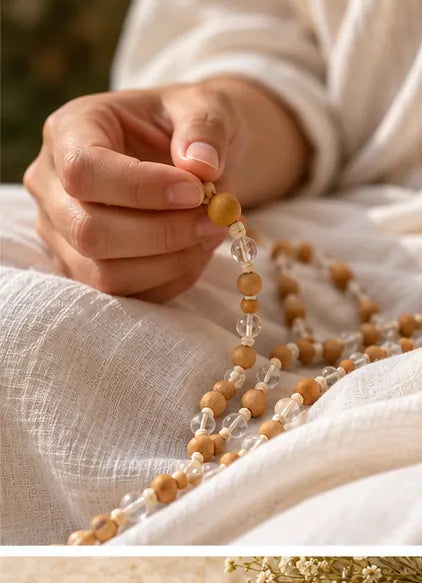
At home, in a bag, across a life
A mala need not be permanently staged on an altar to be treated with care. Some keep it in a pouch between uses; others give it a place near a book, a lamp or a quiet chair. It may be part of a daily devotional practice, brought out occasionally for meditation, or given to someone whose prayer has long been part of the household.
It can also be a significant gift. To a parent who has repeated a familiar name for years. To a friend marking a new season of reflection. To oneself, as a way of giving a long-intended practice a tangible place. The recipient’s relationship with the mala matters more than a caption printed on its box.
Its beauty is never separate from its handling. A long strand draped against cream fabric, a clear bead beside warm wood, the way a knot holds two elements apart: these are details worth looking at even before the first recitation begins.
Care for the strand and the space
Keep the mala dry. Avoid applying perfume, oils or dhoop ash to the beads, knots and cord. Lift it gently rather than pulling at the meru or tassel; do not twist the strand tightly around the wrist or store it under heavy objects. Wipe beads softly with a dry cloth and return the mala to its pouch when it is not in use. Do not pull or twist the ganthan.
Burn dhoop separately with appropriate ventilation. Let ash cool before cleaning up. Neither flame nor ash should touch the mala.
The next bead
One hundred and eight is a large number until it is taken one bead at a time. Ganthan makes space between them. The meru lets you recognise a full circle. Chandan and clear crystal give the strand its warmth and light. Sandalwood dhoop, if you choose to light it, gives fragrance to the room.
Nothing requires you to hurry toward bead 108. Begin where your hand is. Let one repetition be one repetition. When your attention wanders, the next bead is waiting.
THE OBJECT BEHIND THE STORYChandan
Chandan
& Crystal
Japa Mala.
108 counting beads. One meru. Ganthan between the moments.
EXPLORE THE MALA ↗Sources & further reading
[1] Himalayan Academy — Path to Siva, chapter 45. A Śaivite description of japa with 108 beads.
[2] ISKCON Educational Services — Other Forms of Worship. Another Hindu teaching resource describing japa and 108 beads.
[3] Himalayan Institute — String of Pearls: How to Use a Mala. Knots, meru and reversing direction at the junction.
[4] Gemological Institute of America — Amethyst: A Variety of Quartz. The name rock crystal for colourless quartz.
[5] Sri Sringeri Sharada Peetham — Sri Janardana. A specific devotional use of sandal paste in India.
[6] Kyoto National Museum — The Aesthetic Pleasures of Incense. Incense and fragrant wood in Japanese history.
[7] U.S. Environmental Protection Agency — Sources of Indoor Particulate Matter. Ventilation when burning incense indoors.
Editorial note
This article gathers information from named teachers, religious institutions, a museum, a gemological reference and an indoor-air resource; their source links are listed above. Each speaks from its own context and does not endorse INDIELIXIRS®, its affiliates, employees or products. Ritual details vary by lineage, so a person’s own teacher or tradition takes precedence over this general editorial account. The historical references do not identify the botanical species or exact provenance of an individual wooden bead, nor certify the material composition of an individual crystal bead or dhoop stick. Symbolic language and suggested personal reflections are INDIELIXIRS® editorial interpretations. The mala and dhoop are not offered as medical treatments or guarantees of emotional or spiritual outcomes.