

Cart
0
There is a particular hour when a day becomes crowded. One message asks for an answer; another asks for your attention. An unfinished thought follows you from one room into the next. Even when the room is quiet, your mind may still be moving at the speed of everything that happened in it.
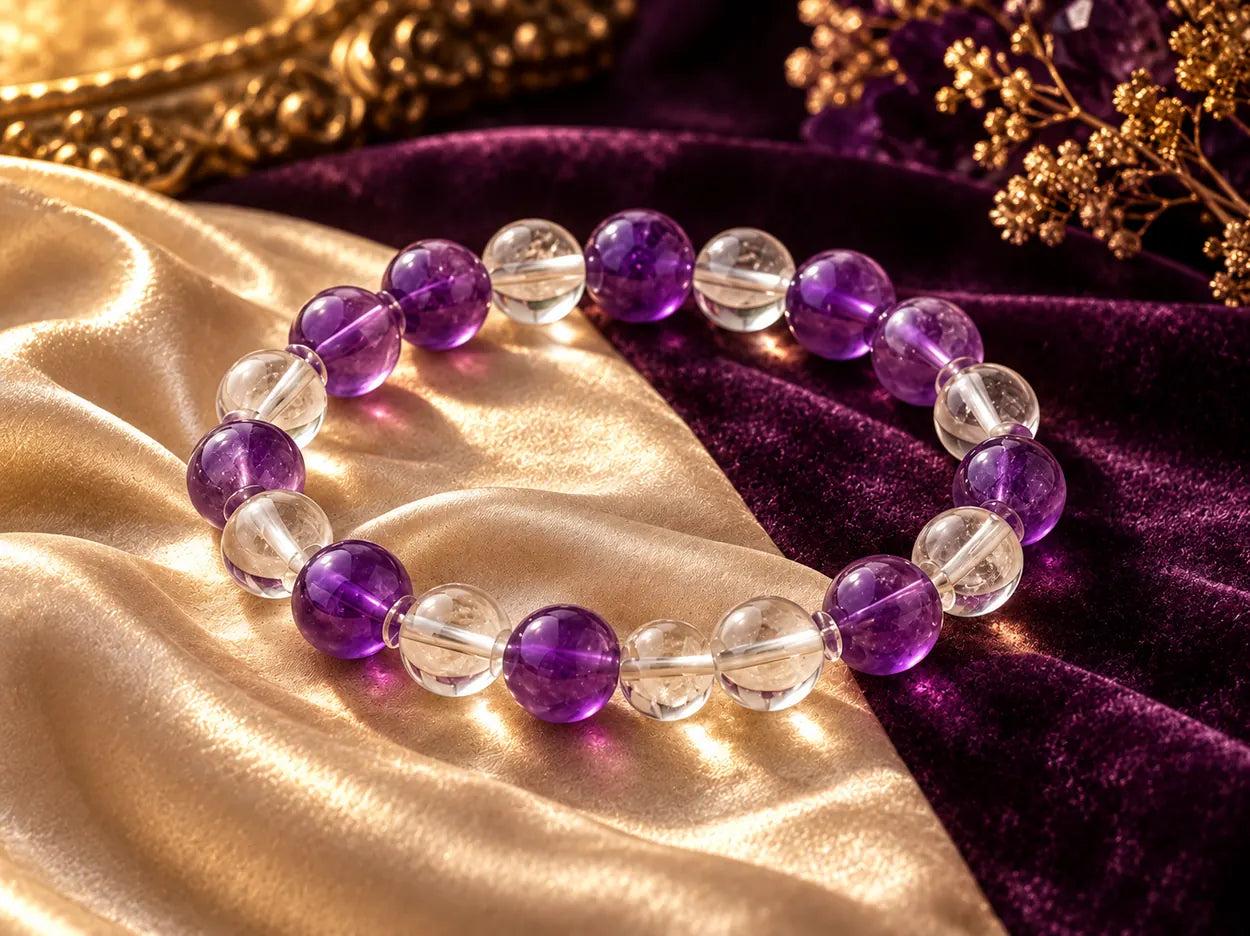
This is the moment behind the Amethyst & Crystal Bracelet. Not the promise of a perfectly silent mind. A smaller, more human invitation: pause long enough to notice what is happening, then choose where your attention goes next.
Two kinds of quartz carry that idea in color. Amethyst gathers light into violet. Clear crystal lets it pass through. One appears deep, the other open. Together they make an especially beautiful way to remember that clarity can begin with a pause.
A note on meaning: The mineral facts in this story come from gemological references. Historical and religious passages describe beliefs and practices in their own settings. Our reading of the bracelet as a cue to pause is an INDIELIXIRS® editorial interpretation, not a measured property of the stones.

01 / The same mineral family, two ways of holding the light
A bracelet made from a quiet contrast
The material relationship here is closer than the colors suggest. Amethyst is the purple variety of quartz; transparent colorless quartz is commonly called rock crystal. Quartz is silicon dioxide, written SiO₂. Purple and colorless beads are thus two visual expressions of the same mineral family. [1][2][3]
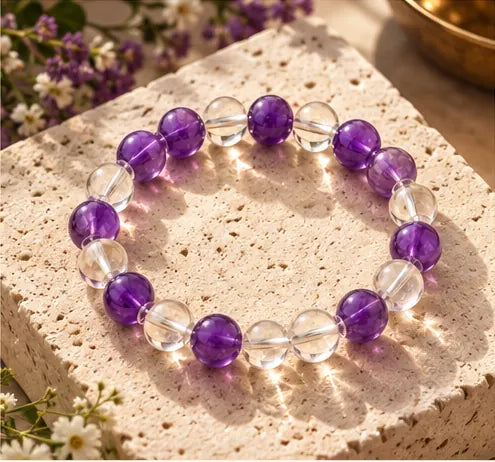
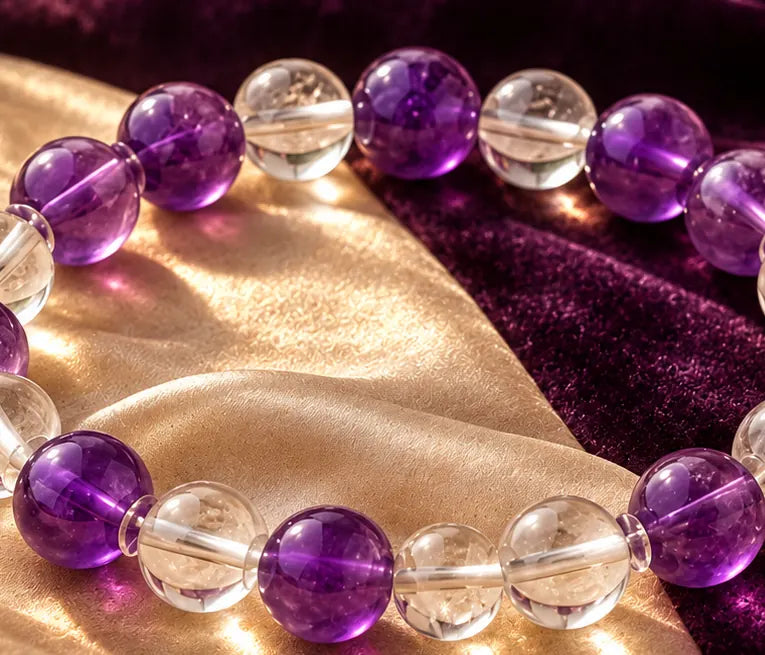
That kinship is the design’s starting point. Side by side, the beads change the way a wrist catches the light: violet gives the eye somewhere to settle, while the transparent beads let the arrangement breathe. The colors can feel like night meeting morning, ink meeting paper, or a full thought followed by a little space. These are ways to read the design, not geological claims.
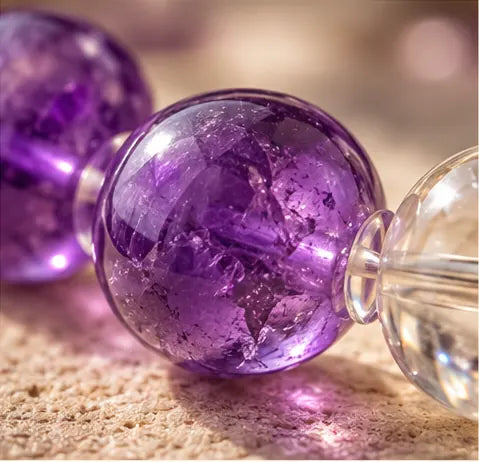
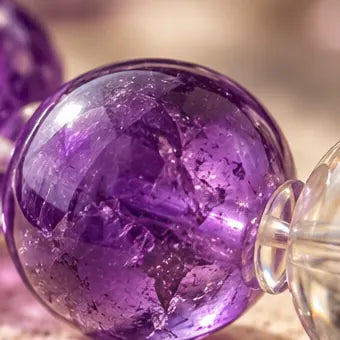
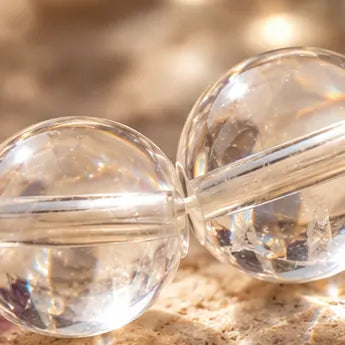
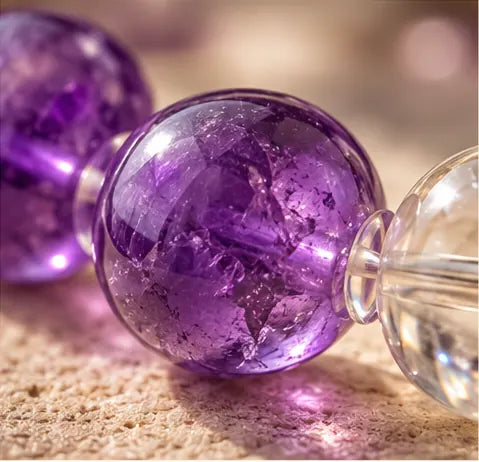
Close inspection rewards a slower look. A purple bead may seem dark until it turns toward a window. A clear bead may reveal a line, a reflection, or the cord passing through it. Variations between individual beads are part of the visual experience of a bracelet made with stone; photographs and lighting can make colors appear different from the piece in hand.
 AMETHYST pause / violet / quartz
Amethyst: violet, history, and the idea of restraint
Amethyst owes much of its cultural reputation to a story hidden in its name. The Greek amethystos means “not drunk.” The Gemological Institute of America records the old belief that amethyst could prevent intoxication and notes its long association with the color of wine. It is a remarkable piece of gem lore. It is not evidence that wearing amethyst affects alcohol, judgment, or health. [1][4]
What can we take from such a story today? Perhaps a question rather than a supernatural answer: What would it mean to keep my head when the world around me is noisy? The Greek association gives contemporary wearers a vocabulary for restraint and presence. It does not make the bracelet a protective device. The distinction matters because a metaphor can be useful without being literal.
The range of purple is part of amethyst’s appeal. Some stones lean toward lavender; others hold a deeper violet. In jewelry, that range allows a single color to change mood with the light. Against a white shirt it can feel crisp; against charcoal or midnight blue it grows more inward and dramatic. [1]
For this Journal, amethyst is the pause in the composition. Let your eye rest on one violet bead. Feel the bracelet touch your wrist. No need to empty your mind, force a feeling, or believe a stone has done anything to your body. The first act is simply to notice.
 CLEAR CRYSTAL room / light / quartz
Clear crystal: room for the light
“Crystal” can mean many things in everyday speech. Here, clear crystal refers to transparent, colorless quartz, also called rock crystal. It shares quartz’s mineral identity with amethyst, although it gives a very different visual impression. [2][3]
Rock crystal has appealed to makers for centuries. The Metropolitan Museum of Art holds a Greek Hellenistic rock-crystal ring dated to the second or first century BCE. That object tells us something modest and fascinating: people valued this transparent material as an object of craft and adornment long before a modern wellness vocabulary was attached to it. It does not establish any healing effect. [5]
Look through a clear bead and the view changes with your position. Light, background, and neighboring purple stones enter the same little circle. Its beauty lies less in a fixed color than in its openness to the surroundings. For this bracelet, we call that openness room: a visual reminder to make space between a feeling and a response. It is a design metaphor, not a claim that quartz produces or amplifies an invisible force.
If amethyst asks you to stop for a beat, the clear beads ask what you might see once you have stopped. A hard conversation may still be hard. A decision may still take time. But a moment of observation can change the way you meet it.
“Returning is part of practice. It is not a failure to have wandered.”
Where stone symbolism meets contemplative practice
People have used objects to mark attention across many cultures: a candle in a room, a page opened to a familiar passage, a string of prayer beads, a small item carried in a pocket. Their religious uses differ deeply, and this bracelet is not a substitute for any of them. Its possible role is simpler: a personal reminder you can choose to attach to a practice.
The Bhagavad Gita 6.26 describes the wandering mind being brought back to the Self. The verse belongs to a specific spiritual teaching; it does not prescribe amethyst, quartz, or an INDIELIXIRS® bracelet. Still, its recognition that attention wanders can speak to a common experience. Returning is part of practice. It is not a failure to have wandered in the first place. [6]
Modern descriptions of meditation also include attention to a breath, sound, image, or repeated phrase. The U.S. National Center for Complementary and Integrative Health describes mindfulness as attention to the present moment without judgment. Research into mindfulness has examined possible benefits, but findings depend on the practice and context; none of that research establishes a clinical benefit from this bracelet. [7]
A visible object on the wrist can be used as a chosen prompt: “I noticed the beads; I will take a breath.” That is an action a person takes. It leaves room for faith, secular reflection, or simply an appreciation of the bracelet’s colors, without assigning the stones a medical role.
The one-minute pause
Try this on a day that moves too quickly. You can do it with the bracelet on, in your hand, or without an object at all.
1 · Feel. Notice the bracelet on your wrist or the contact of your feet with the ground. Allow one ordinary breath to finish. Do not change it unless you wish to.
2 · Name. Silently name what has your attention: “I am preparing for a conversation,” “I am tired,” or “I am deciding what matters first.” There is no need to judge the answer.
3 · Choose. Ask, “What is the next kind action I can actually take?” It might be sending one message, stepping away for a moment, asking for help, or returning to the task in front of you.
If this practice does not appeal to you, wear the bracelet for its form and color. A beautiful object does not need to carry a ritual to be worth wearing.
Worn through an ordinary day
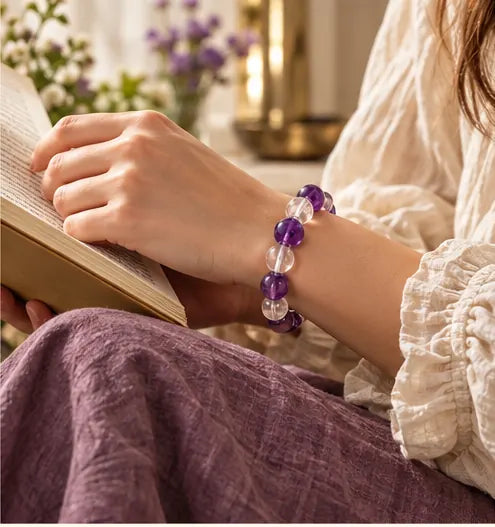
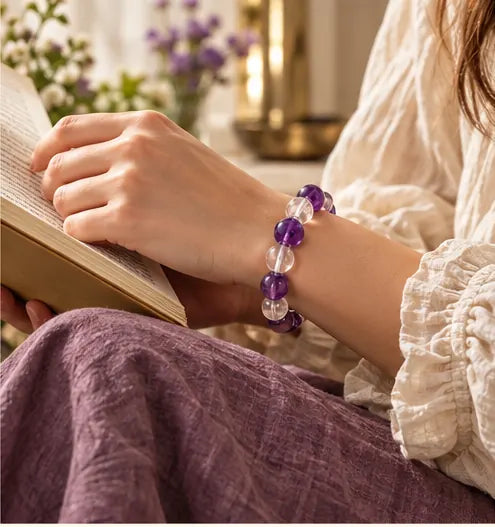
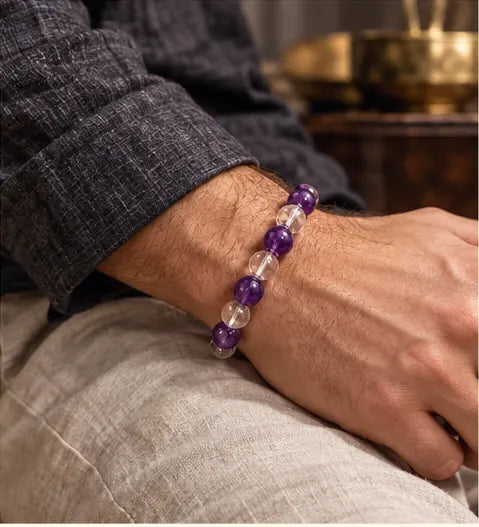
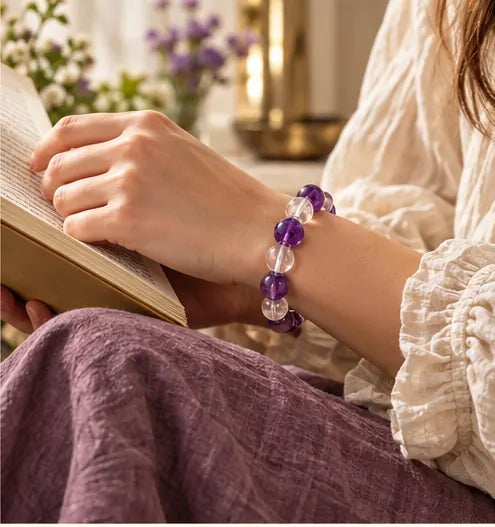
The bracelet belongs just as easily beside a watch as it does on its own. A dark sleeve brings the amethyst forward; cream and linen make the transparent beads luminous. In photographs, the same design can move from a desk in afternoon light to a dinner table without changing its character.
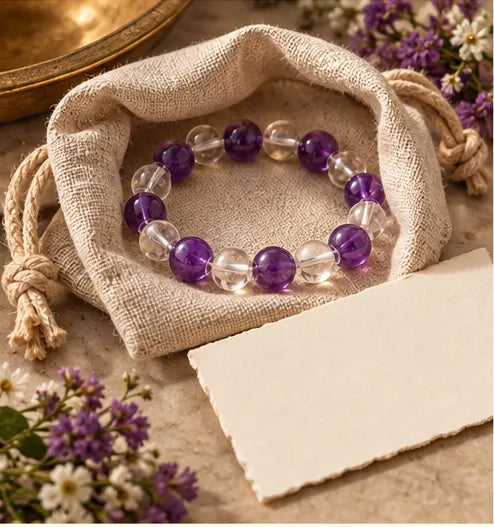
It can also be given as a thoughtful gesture. For someone starting a new chapter, going through a busy season, or simply drawn to purple, the message might be: “Here is a small reminder to take your time.” Avoid promising another person that the stones will calm their mind or solve a difficulty. The gift is the object and the meaning you offer with it; the recipient makes that meaning their own.
We like the fact that the design is not confined to one gender, one occasion, or one belief. Some people will see the contrast of minerals. Others will notice the Greek history, the idea of returning attention, or only how it feels to wear something lovely. These readings can coexist without becoming claims about what every wearer will experience.
THE ART OF GIVING
For someone who could use a moment of their own.
Looking after the bracelet
Amethyst is suitable for everyday jewelry, but take care with sudden temperature changes and long exposure to intense light: the Gemological Institute of America notes these can affect the stone. Keep the bracelet away from heat and harsh household products. Gently wipe the beads with a soft cloth after wear; for a strung bracelet, avoid soaking the elastic and let the piece dry before storage. Store it separately from harder or sharp jewelry that could mark the beads. [8]
If you use it as a reminder to pause, it needs no formal “activation.” You can simply decide what the bracelet means to you. A private sentence on the morning you first wear it is enough: “When I notice this, I will give myself one moment.” That sentence is a personal choice, not a requirement attached to the minerals.
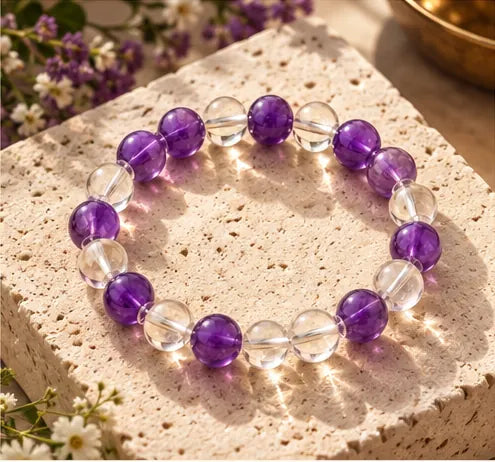
Two stones, one intention
Violet and transparency. Depth and openness. Amethyst and clear crystal look different but belong to the same quartz family. That is the bracelet’s quiet surprise.
It cannot make decisions for you. It cannot remove a difficult day. It can be a beautiful place to let your eye land while you do the small, consequential work of noticing and choosing. Sometimes a moment is enough to begin again.
THE PIECE BEHIND THE STORY
Amethyst & Crystal Bracelet
Violet depth, transparent light. An everyday reminder to take a moment.
Explore the bracelet ↗Sources and further reading
[1] Gemological Institute of America — Amethyst overview. Purple quartz, color range, and the historical meaning of amethystos.
[2] U.S. Geological Survey — Quartz. Quartz as silicon dioxide (SiO₂).
[3] Gemological Institute of America — Amethyst, a variety of quartz. The name “rock crystal” for colorless quartz.
[4] Gemological Institute of America — Amethyst history and lore. Historical beliefs and artistic associations.
[5] The Metropolitan Museum of Art — Rock crystal ring. Greek Hellenistic object, 2nd–1st century BCE.
[6] IIT Kanpur Gita Supersite — Bhagavad Gita 6.26. Text and commentary on returning a wandering mind to the Self.
[7] U.S. National Center for Complementary and Integrative Health — Meditation and mindfulness. Definitions, research context, and limitations.
[8] Gemological Institute of America — Amethyst care and cleaning. Light, heat, cleaning, and durability guidance.
Editorial note
This article brings together information from gemological institutions, a museum collection, a religious text, and a public health research agency; direct links are included above. Statements about those sources reflect the cited material and are offered for general cultural and educational interest. The sources do not endorse INDIELIXIRS® or its products. The source authors’ views and traditional interpretations are their own and should not be taken as statements, personal advice, or guarantees from INDIELIXIRS®, its affiliates, or its employees. Descriptions of the bracelet’s styling and the symbolic “pause” and “room” are INDIELIXIRS®’s editorial interpretation. The bracelet is not a treatment, and neither this article nor the product guarantees a health outcome.