

Cart
0
STONES & STORIES / 08O
INDIELIXIRS® Journal · Stones & Stories · Upcoming bracelet
There are days when the idea is vivid and the action is absent. The page stays blank. The message remains unsent. The shoes sit by the door. We wait for certainty to arrive and give us permission to move.
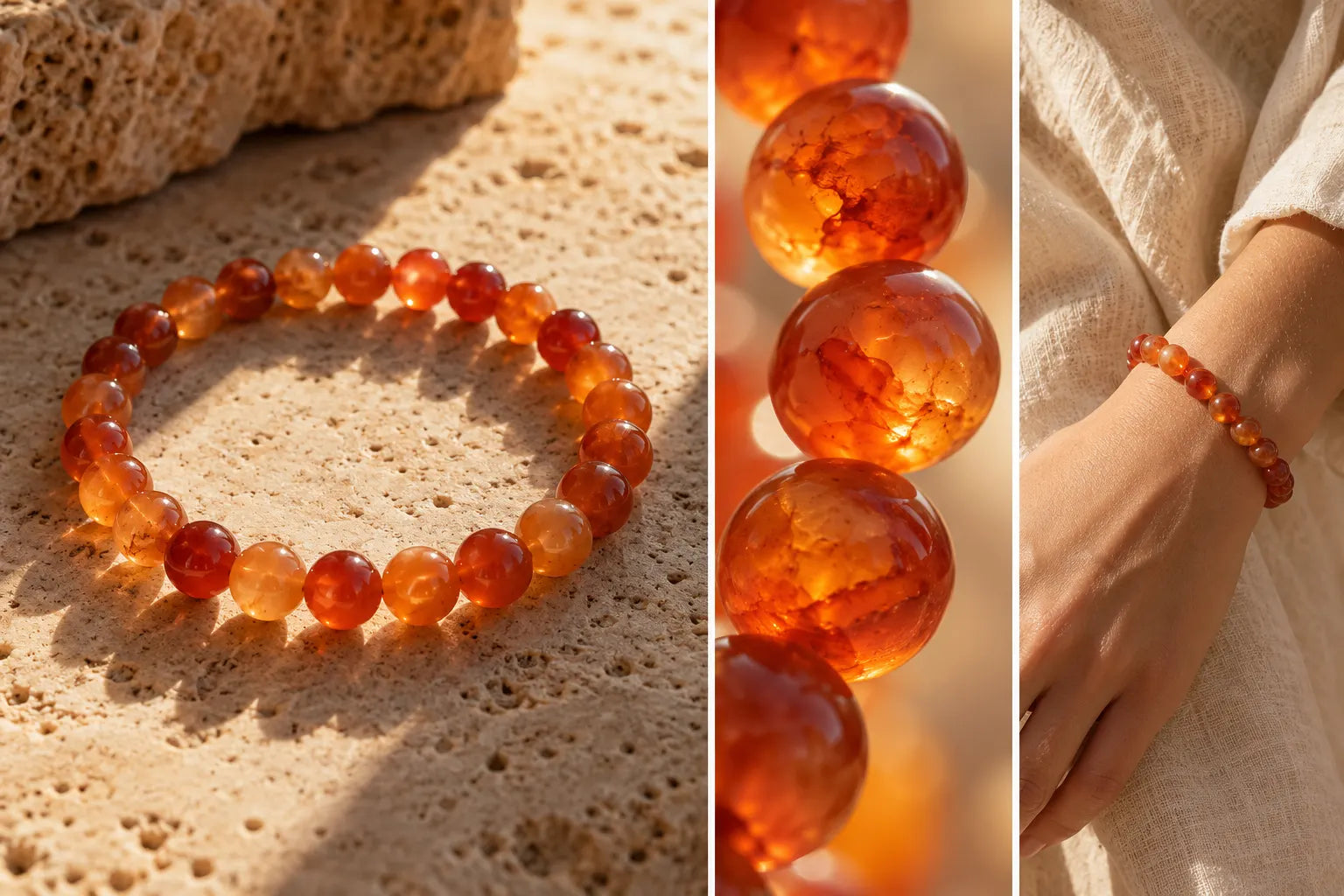
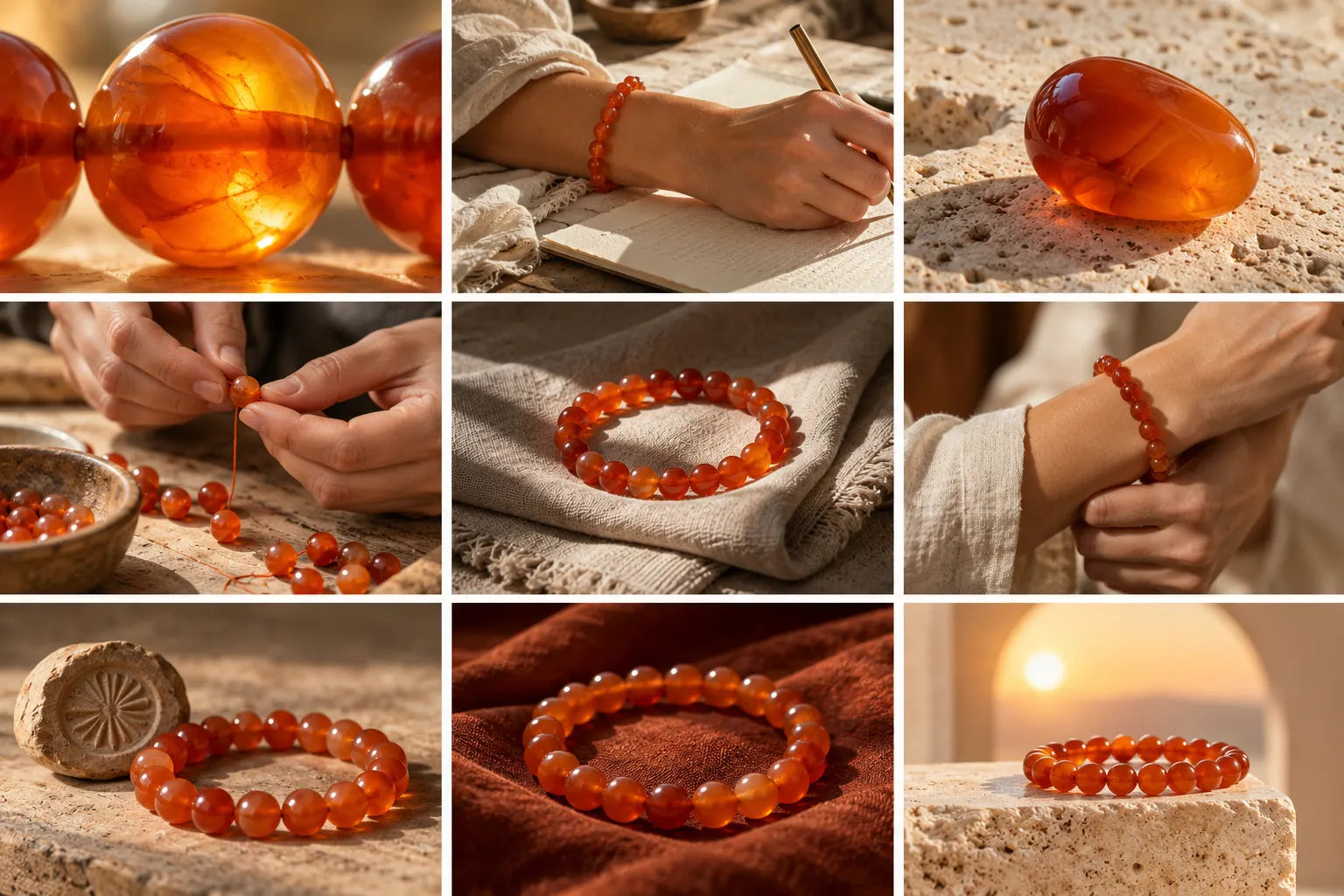
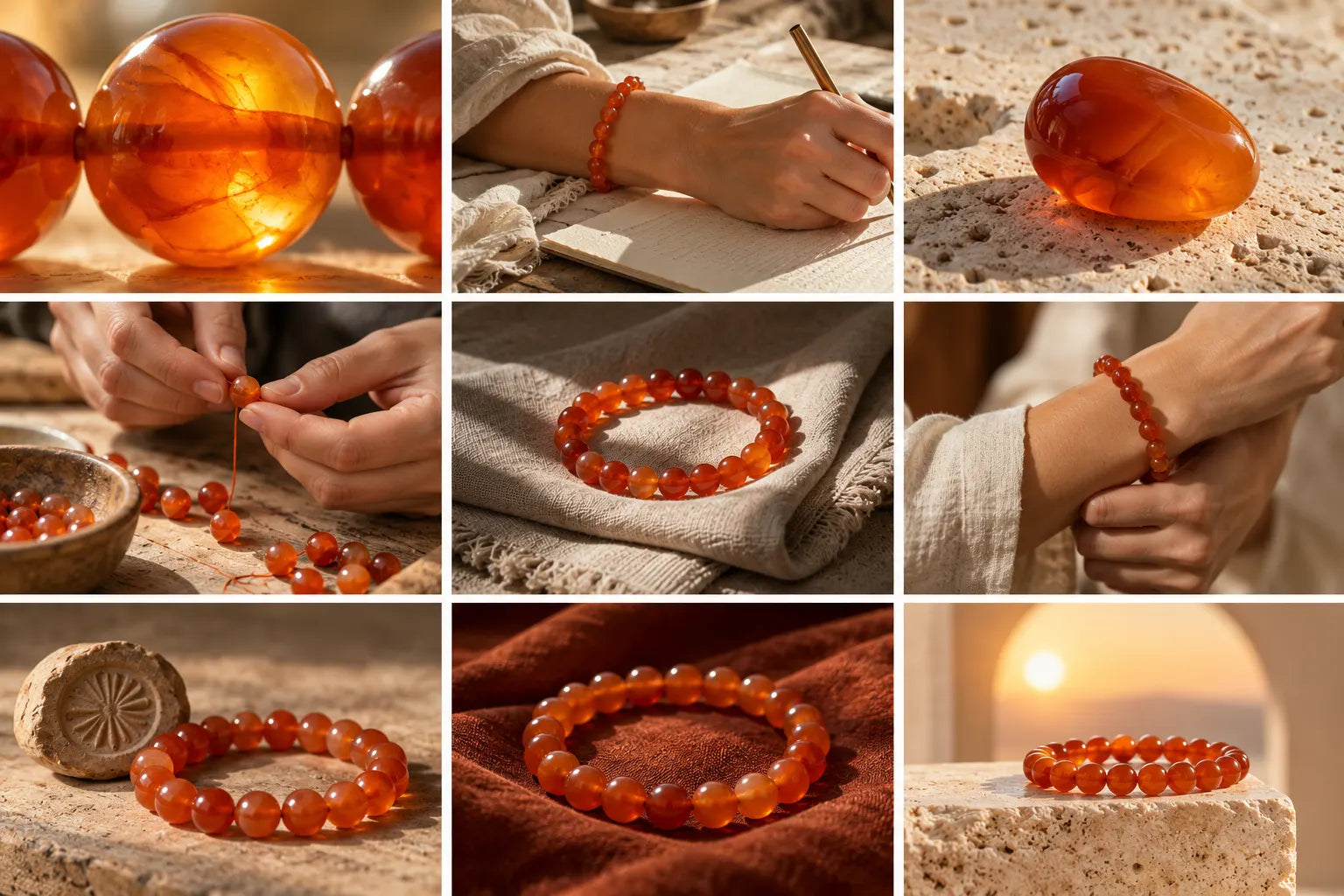
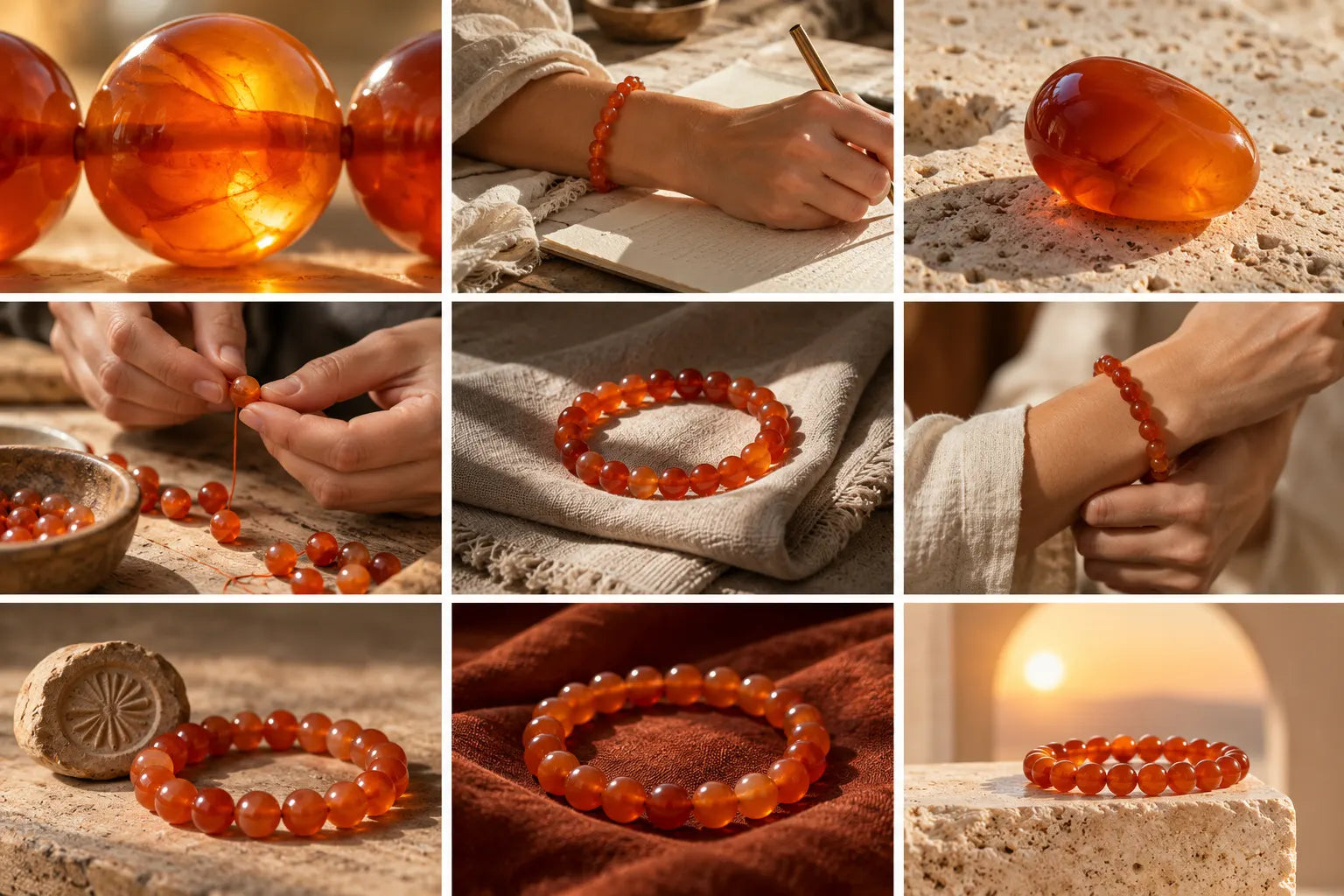
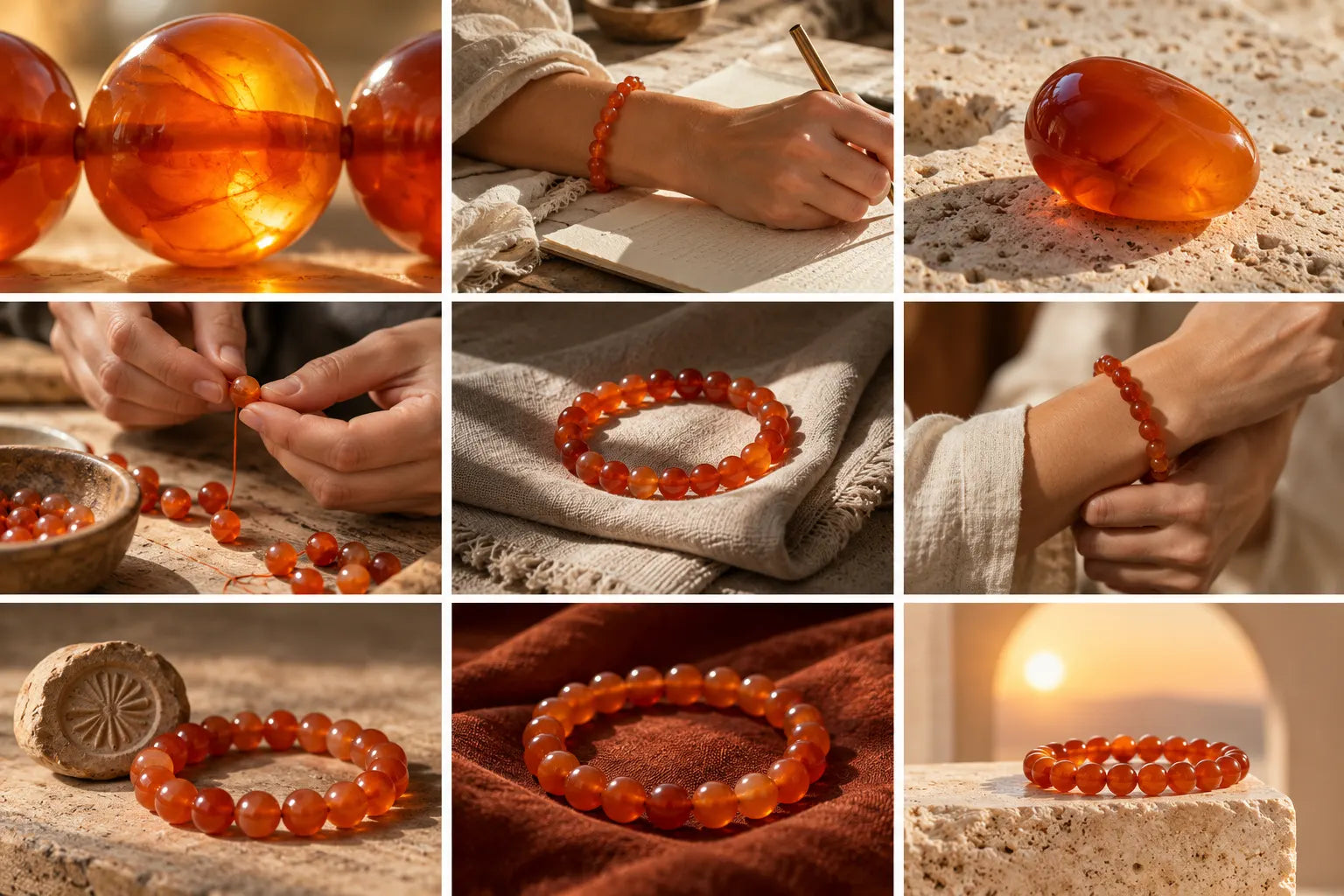
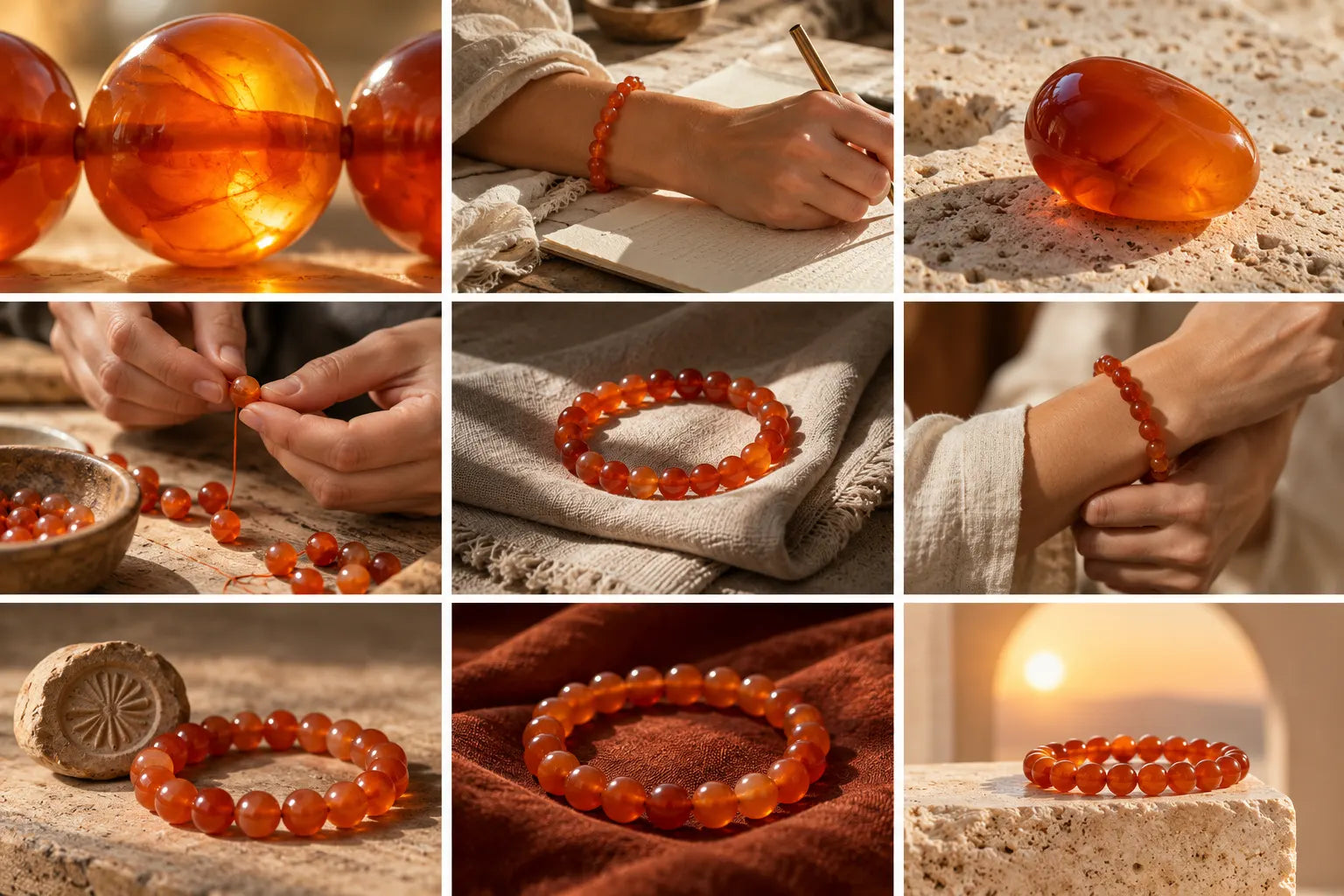
Orange carnelian has a way of catching the eye precisely then. Hold one bead towards a window and light travels into it; its colour can seem to come from within. Look again and there are darker passages, cloudy veils, shades of honey, apricot and ember. The stone does not offer a timetable for change. It offers an image you can carry: something warm enough to invite a beginning.
This is the story we would tell around an INDIELIXIRS® orange carnelian bracelet: not about sudden transformation, but about the living space between I want to and I began.
A question to wear: What would you make if you allowed yourself an imperfect first version?
01 A CARNELIAN STORY
A stone with light inside it
Carnelian belongs to the chalcedony family, within the wider quartz family. In jewellery it is loved for a colour that can move from clear orange through reddish orange and deeper russet. Its appeal is also about the way it handles light: a polished bead can look quiet on one side and luminous on another. The individual surface, tone and translucency of any bracelet will belong to the actual stones chosen for it. [1]
A round bead is a particularly intimate way to meet that colour. A museum object sits behind glass; a bracelet crosses the day with you. The beads roll slightly when you reach for a notebook, put on a jacket, hold somebody’s hand, or return to a task that seemed difficult an hour before. In that repeated contact, colour becomes part of an ordinary life.
If purple amethyst can suggest an inward pause and Tiger Eye can evoke the courage to continue, carnelian feels like a warmer verb: make. Not a guarantee of productivity. A word to keep near the skin.
02 A CARNELIAN STORY
From the Indus to distant shores
Long before a contemporary bracelet could call carnelian a “creativity stone,” people were choosing, cutting, drilling, polishing and exchanging it. The British Museum describes etched carnelian beads made in the Indus Valley from around the middle of the third millennium BCE. Its research follows a demanding technique in which a pale design was applied and fired into the stone; the beauty was the result of knowledge and patient work, not a spontaneous miracle. [2]
A carnelian bead travelled because someone made it worth carrying. The British Museum records carnelian in Mesopotamian jewellery and describes possible routes from Iran or the Indus Valley. Its account of East African trade also notes carnelian beads imported largely from India. These objects cannot be reduced to a single unbroken belief about the stone: the makers, wearers and journeys changed across place and time. Yet they leave a striking shared thread. People went to considerable effort to bring this orange material into human hands. [3, 4]
When we say the stone evokes movement, we are making a present-day reflection upon that physical history. The beads themselves crossed distances. The people who worked them learned through repetition. Each finished object began as a decision to start.
ACROSS DISTANCE AND TIME
Every finished bead
began with a decision
to start.
03 A CARNELIAN STORY
Egypt: colour, form and protection
At the Metropolitan Museum of Art, small ancient Egyptian amulets shaped like hands and feet preserve a more specific story. The museum describes how such amulets could be included in bracelets and anklets; carnelian’s red-orange colour was associated with blood, energy and the hoped-for protection of limbs. The museum also notes possible associations with dexterity and creative potential. [5]
Those meanings belong to the historical objects and the people who made and wore them. A modern round-bead bracelet is not an Egyptian amulet. It would flatten an entire culture to suggest that putting on contemporary jewellery recreates an ancient practice. But a beautiful question survives the comparison: what does it mean when a person gives an object a place near the moving hand?
Perhaps a hand is where intention meets the world. It marks the page, prepares the meal, opens the door, takes the first step by reaching for something. We can admire the historic object and still make room for our own, different, private meaning.
04 A CARNELIAN STORY
A mark that says: I was here
In the Greek and Roman world, carnelian was also carved into small intaglios. The Met holds Roman examples, including a third-century CE gold ring with a carnelian intaglio. The stone was a surface for a deliberately cut image, worn close and capable of carrying identity. [6]
There is a compelling difference between a seal and an uncarved bead. A seal leaves a mark; a bead can become the mark you leave on your own day. You do not need a grand declaration. You may only need to write a line, begin a conversation, try a colour, or allow the first rehearsal to sound imperfect.
Begin small enough that you can actually begin.
05 A CARNELIAN STORY
Carnelian in South Asian and Islamic artistic histories
The carnelian story also lives in a different scale and setting in Mughal art. A GIA Gems & Gemology study of the Taj Mahal’s inlay discusses the stone’s importance within Islamic cultural accounts and the wider history of gems cherished in India, Iran, Mesopotamia and Egypt. It records beliefs and traditions surrounding carnelian while discussing the craft and material choices of the inlay. These are historical accounts, not instructions or promises for someone wearing a bracelet now. [7]
What interests us is not borrowing authority from a sacred tradition. It is the persistence of the stone across craft, devotion, architecture and everyday adornment. An orange bead on the wrist belongs to a different object and a different moment, but its colour invites the same human instinct to notice and choose.
06 A CARNELIAN STORY
The second centre: Svadhisthana and the colour orange
In many contemporary chakra teachings, the sacral centre is called Svadhisthana (also written Swadhisthana). It is placed in the pelvic or lower abdominal region and associated with water, movement, pleasure, adaptability, relationships and the capacity to create. Yoga International describes a six-petalled orange lotus in a popular depiction; the Himalayan Institute connects Svadhisthana with water and the pelvis. [8, 9]
It is worth looking closely at the pairing of an orange stone with a water-associated centre. The orange is visually warm, but the metaphor here is not necessarily fire. It can be a river of ideas, an ability to change shape without losing oneself, a renewed taste for life, or a willingness to enjoy what one makes. A person painting again, entering a relationship with more honesty, or allowing a first draft to be messy might recognise something of this language.
There is also room for different readings. The Himalayan Institute notes that chakra colours have not been fixed in one uniform way across older texts and lineages; its discussion of an older Sanskrit description refers to a vermilion lotus and a white crescent associated with water. Today’s neat “second chakra = orange = carnelian” pairing is a widely used contemporary interpretation, not a rule every historical yogic tradition gave for a gemstone bracelet. [10]
Some modern crystal practitioners place carnelian in that orange sacral story because its colour seems to echo it. Others give carnelian a different chakra correspondence, or use no chakra map at all. One person may wear it as a focus for creative practice; another may see in it confidence, warmth or simply excellent design. No single reading has to be imposed upon the wearer.
The sacral question: Where could I allow a little more flow, play or honest expression into my day?
07 A CARNELIAN STORY
The language of energy, held with care
In contemporary crystal practices, carnelian is often described in the language of vitality, creative expression, confidence, motivation, and the sacral chakra. Some wearers speak of it as a companion for the first day of a project, a difficult conversation, a return to dance, or simply a less apologetic way of taking up space.
That language names aspirations and personal experience. People use different spiritual maps, and the word energy can mean different things within those maps. An INDIELIXIRS® bracelet need not prescribe one tradition or promise a result. If such meanings resonate with you, the bracelet may become a personal symbol for them. If they do not, its colour and craftsmanship remain reason enough to love it.
The most generous reading may be this: an object cannot do your living for you, but it can be present when you do it.
08 A CARNELIAN STORY
Stories and beliefs carried across places
No one culture owns the meaning of this stone. In the Indus Valley, the preserved evidence tells a story of skilled artisans and intricate etched beads; in ancient Egypt, the Met describes protective hopes invested in small carnelian amulets; in the Roman world, a carved stone could carry a personal image on a ring. In the Mughal artistic context examined by GIA, historical accounts add associations drawn from Islamic culture. These are related through the material, yet each has its own date, purpose, people and voice. [2, 5, 6, 7]
Contemporary wellness circles add further chapters. In crystal healing language, carnelian is often called a stone of motivation or courage. In chakra meditation it is often placed near an orange visualisation of Svadhisthana. In a creative ritual, an artist might leave a bead beside a notebook until the next idea comes. For someone else, a bracelet is an outward sign that they are ready to be seen. The common thread is how humans use objects to hold hope and attention; the meanings themselves are not interchangeable.
The stone's reputation for “energy” is especially broad. It may mean physical vigour to one person, confidence in a room to another, or simply an uplifting impression made by warm colour. We can honour the traditions and tell their stories without promising that one person’s experience can be passed automatically to another.
09 A CARNELIAN STORY
What wearers elsewhere have actually said
When we look beyond lists of supposed properties and read people’s own words, the picture is more human. These accounts concern other sellers’ carnelian pieces, not the INDIELIXIRS® bracelet. They are personal reports rather than verified outcomes, and they are not all about the same kind of bracelet.
A British wearer, on the pleasure of the colour. In a verified Trustpilot review of a carnelian chip bracelet sold by a UK shop, one buyer wrote that wearing it cheered her up “like sunshine.” Another buyer on that same page admired how it glimmered when held to the light. These are modest, vivid benefits: delight in appearance, and an emotional lift the wearers themselves describe. [11]
An account from India, about choices after grief. In a review of an Indian healing practice, a client describes being advised to wear a red carnelian bracelet after losing a younger brother and later feeling more able to make positive life choices. The same account also describes counselling, other gemstones, personal belief and the passage of time. It is the reviewer’s story; it cannot tell us which part of a complex life brought about the change. [12]
A marketplace buyer, on the tangible object. A verified Etsy buyer reviewing a small-bead carnelian bracelet praised its beautiful stone quality; another particularly loved the colour of the beads. These comments are about the pleasure of wearing and looking at a piece of jewellery, which belongs beside any discussion of spiritual association. [13]
Across these sources, the benefits people report range from enjoying the glow and feeling cheered to using a bracelet as part of a personal account of more positive choices. Elsewhere in crystal communities, wearers associate carnelian with motivation, creative confidence, courage and feeling more at ease with self-expression. We present such associations as people’s experiences and beliefs. Every INDIELIXIRS® wearer is free to discover their own relationship with the bracelet.
THE INVITATION
An object cannot do your living for you.
It can be there when you do it.
10 A CARNELIAN STORY
Three ways to begin
The unfinished thing. Put the bracelet on before spending ten minutes with a work you have delayed. Not to produce an impressive result; to make contact with the work again. Open the file. Lay out the colours. Write the first awkward sentence. Ten minutes is already a beginning.
The conversation. Touch a bead while asking what you really mean to say. Then say the clearest kind version. Here the stone is a pause for honesty, and the action belongs to you.
The ordinary adventure. Wear the orange with a white shirt, a dark sleeve, handwoven cotton, or an evening look. Let the colour interrupt the familiar outfit. A change in style can be small and still feel like an opening.
None of these is a prescribed ritual. They are invitations to put meaning into use, in ways that fit your life.
11 A CARNELIAN STORY
How orange lives in a wardrobe
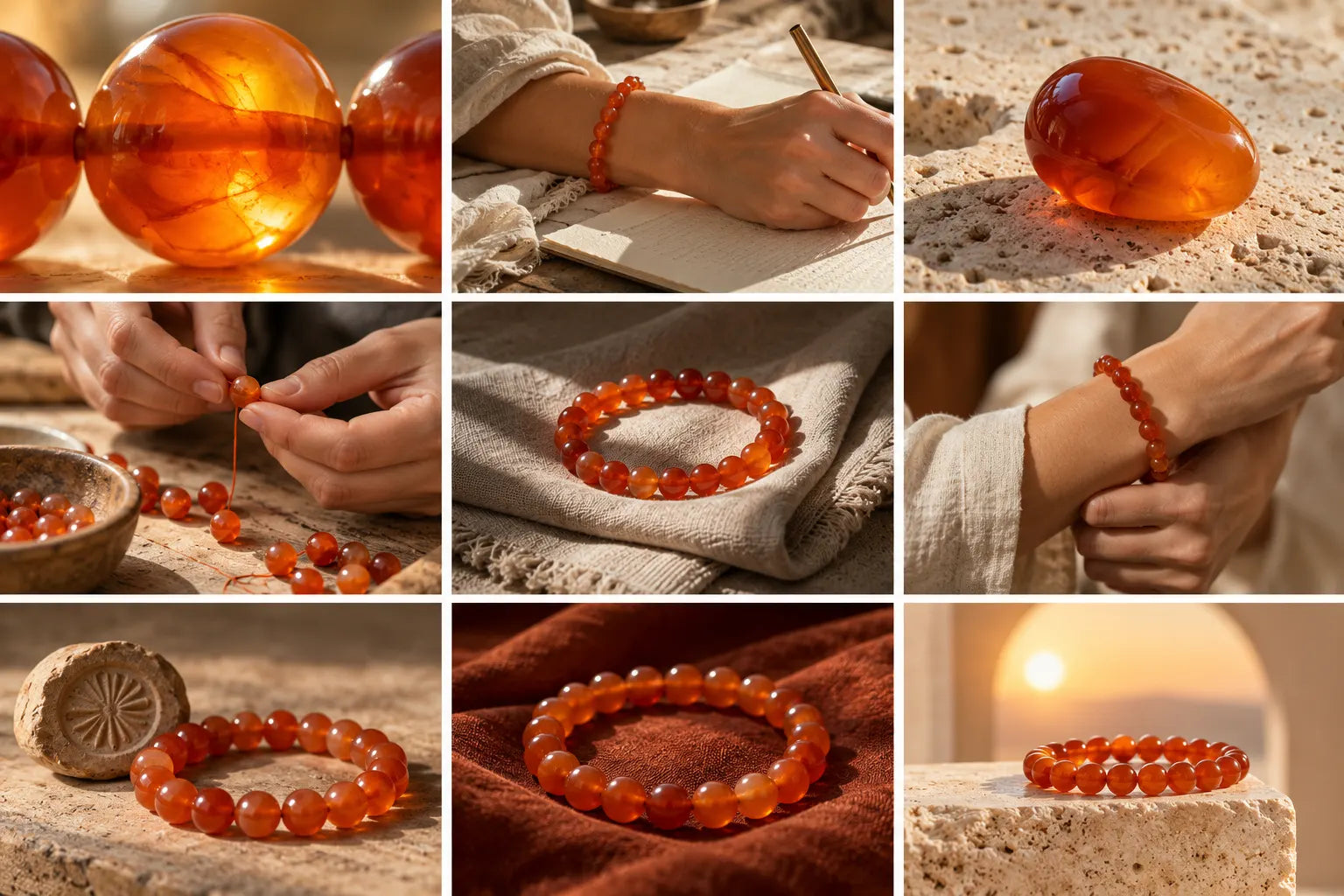
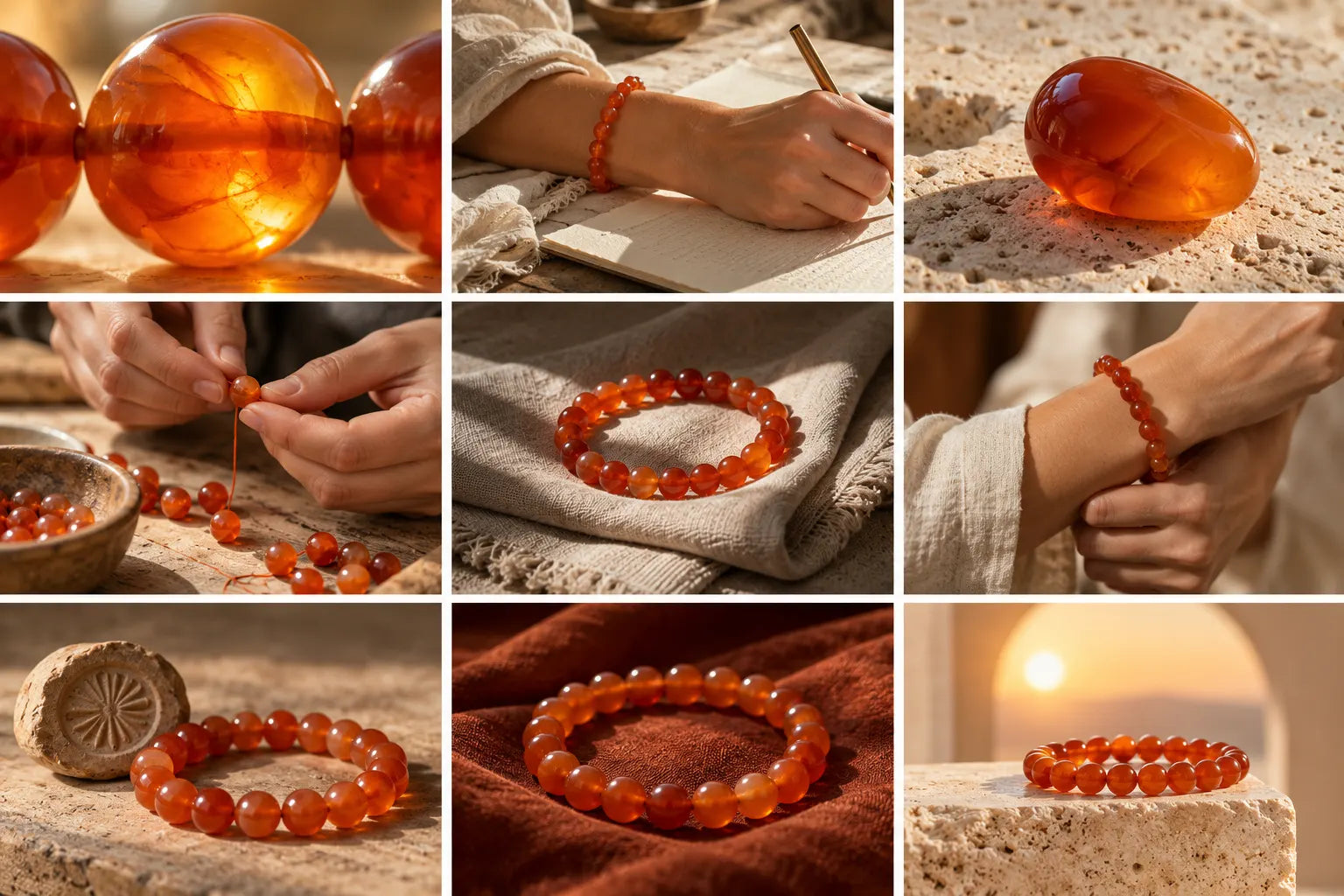
Orange carnelian is unusually versatile because it is not a flat printed orange. The reds deepen in shade; the lighter passages shine against the skin. Against ivory it looks sunlit. With tobacco brown, clay and olive it feels earthy. With charcoal or black it becomes a warm point of focus. Against blue denim the contrast is immediate and easy.
Wear one bracelet as a deliberate, single colour. Place it beside a watch with breathing room, or let it sit alone at the edge of a linen cuff. It does not need a stack of symbolic companions to make its presence felt. When the light changes, the same beads can look different from breakfast to evening.
That is why a close-up belongs on the page, not just an attractive photograph from a distance. The customer should be able to see the glow, the variation and the roundness that make the bracelet worth returning to.
12 A CARNELIAN STORY
The colour you carry into the day
The INDIELIXIRS® Orange Carnelian Bracelet brings this stone’s glowing colour into everyday life. Wear it when you begin something, when you return to it after a pause, or simply when the orange looks beautiful against your sleeve. It can be an intention, a style choice, a gift, or all three. What it comes to mean belongs to the person wearing it.
A bracelet cannot write the first line, speak the honest words or make the choice for you. It can accompany the moment when you do. That is why the question at the end of this story is also an invitation:
What is one small thing you are ready to set in motion?
INDIELIXIRS® / THE BRACELETThe orange
The orange
carnelian bracelet.
The colour of a beginning, made to become part of your every day. Discover the bracelet and find the piece that speaks to you.
EXPLORE THE BRACELET ↗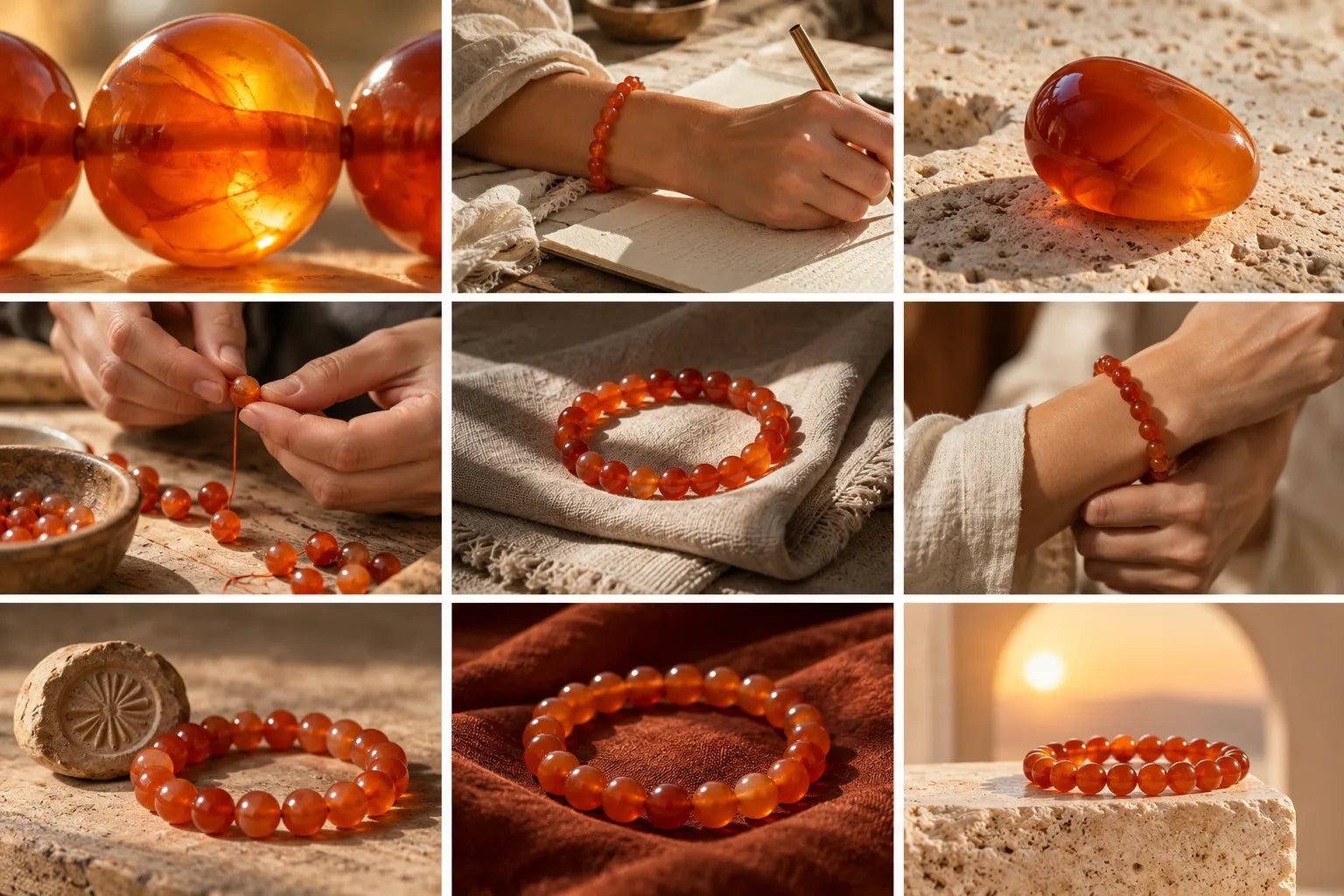
THE READING ROOM
Sources & further reading
[1] GIA, “Gems Formed in Magmatic Rocks,” quartz and chalcedony discussion.
[2] British Museum, “Etching carnelian beads: understanding and reproducing an ancestral technique”.
[3] British Museum, Mesopotamian bead and necklace with carnelian.
[4] British Museum, Room 68 Money Gallery guide, discussion of East African trade.
[5] The Metropolitan Museum of Art, “Hand and Foot Amulets”.
[6] The Metropolitan Museum of Art, “Gold ring with carnelian intaglio”.
[7] GIA Gems & Gemology, “Gemstones in the Era of the Taj Mahal and the Mughals”.
[8] Yoga International, “Your Guide to the 7 Chakras & Their Meaning”.
[9] Himalayan Institute, “The Chakras: Link Between the Macrocosm and Microcosm”.
[10] Himalayan Institute, “5 Common Misconceptions About Chakras”.
[11] Trustpilot, customer reviews of a UK carnelian chip bracelet.
[12] Trustpilot, first-person account mentioning a red carnelian bracelet.
[13] Etsy, verified buyer reviews of a small-bead carnelian bracelet.
Editorial note
This Journal article brings together gemological, museum, cultural, yoga and first-person information from the sources linked above. The historical and cultural descriptions and third-party reviews are attributed to those sources; they are not claims originated, independently verified or endorsed by INDIELIXIRS®, its affiliates or employees. Reflective passages about beginnings, creativity, styling and personal rituals are editorial invitations, not guarantees of emotional, medical, spiritual or professional results. Historical beliefs are presented in their own contexts; individual reviews describe the experiences of other people with other products. For the bracelet’s materials, size and care instructions, refer to its product page.