

Cart
0
The Quiet in Your Hands: Chandan, Crystal and the Ritual of Returning
The INDIELIXIRS® Journal · Stones & Stories · Article 04
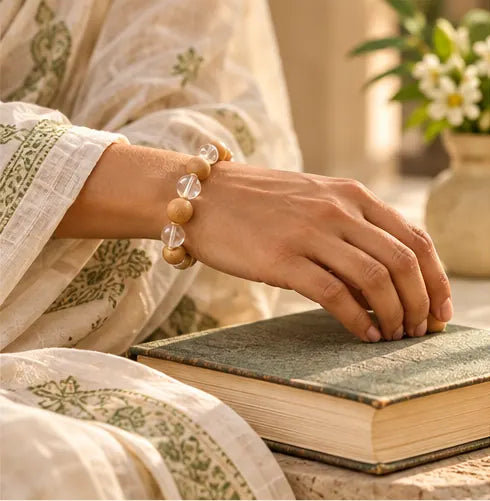
A hand reaches across a desk. A sleeve moves back a little. For a moment, two textures appear at the wrist: the quiet grain of a wooden bead and the brightness of a transparent one. No dramatic gesture, no demand to believe in anything. Just an object that feels different each time your fingers find it.
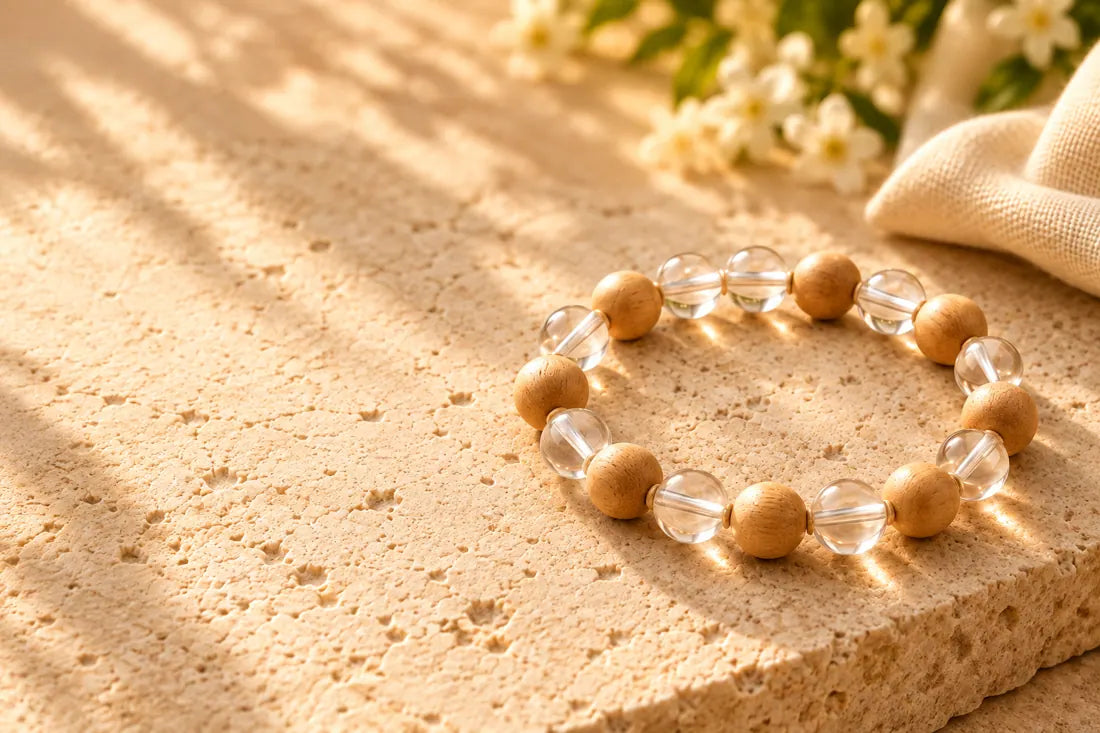
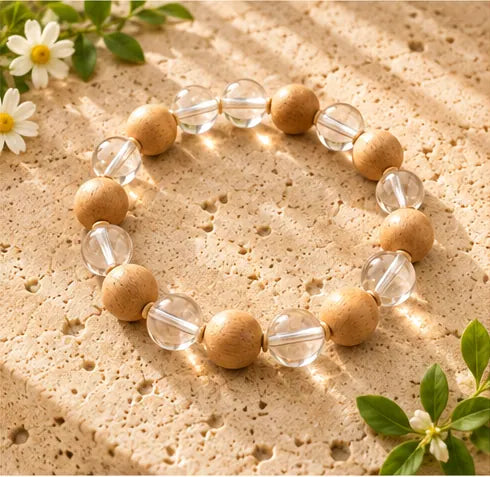
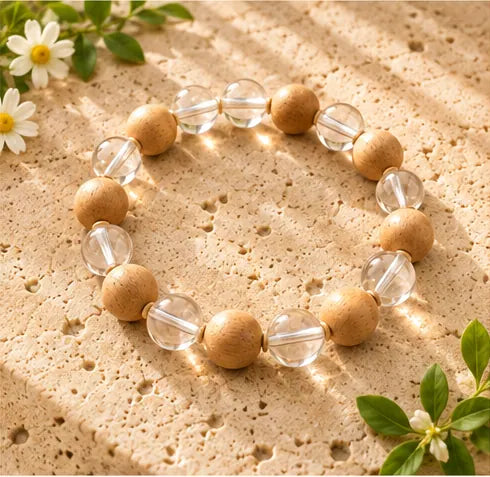
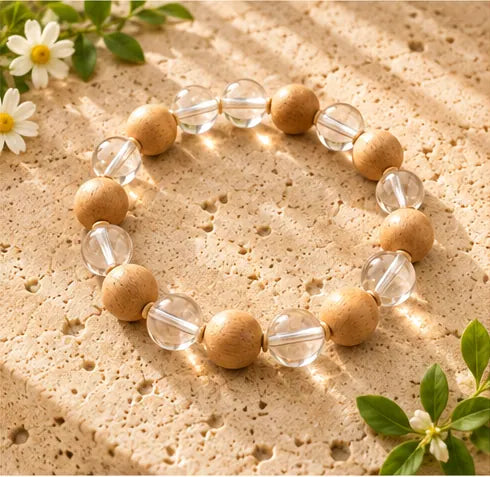
The INDIELIXIRS® Chandan Crystal Bracelet begins with that contrast. Warm wood beside clear stone. A material associated with intimate rituals in India beside a mineral that seems to make space for light. It can be worn simply because it looks beautiful. It can also be worn as a small invitation to return to the present when the day has carried your attention elsewhere.
There is a larger story behind the word chandan. It belongs to Indian languages and religious life, but sandalwood has travelled far beyond one place. In different regions, related fragrant woods have been used for worship, craft, scent, food, and trade. Those stories are connected by material; they are not interchangeable traditions. We will move through them with care before returning to the bracelet on the wrist.
The distinction that matters: Historical references below describe sandalwood in particular cultures. They do not identify the botanical species, origin, fragrance, or treatment of an individual INDIELIXIRS® bead. Our interpretation of the bracelet as a reminder to pause is an editorial choice, not a measurable effect of wood or quartz.
The bracelet: warmth beside light
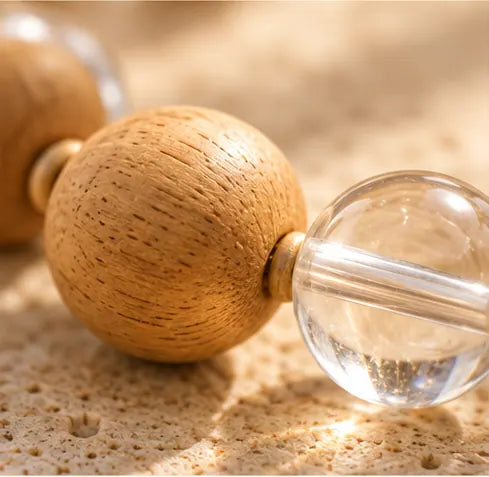
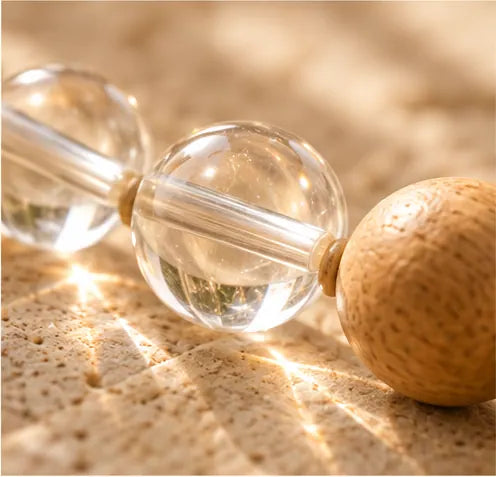
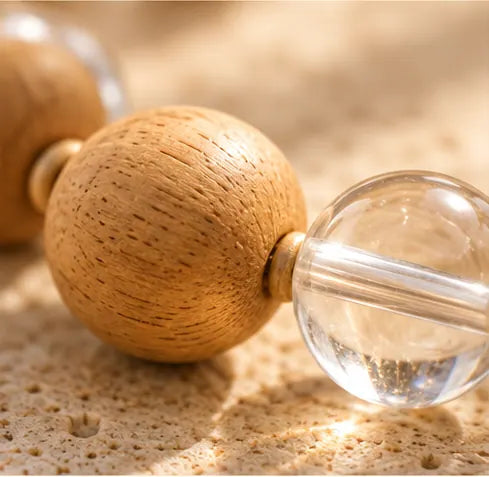
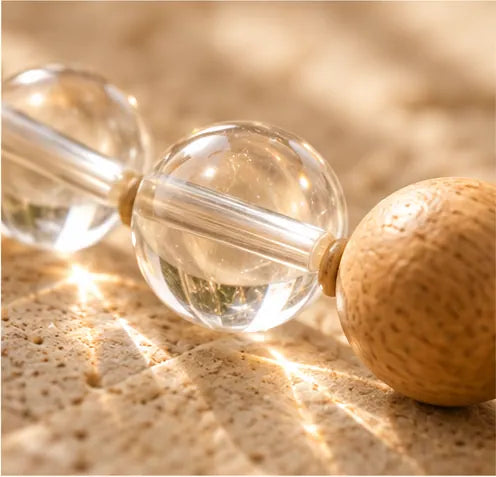
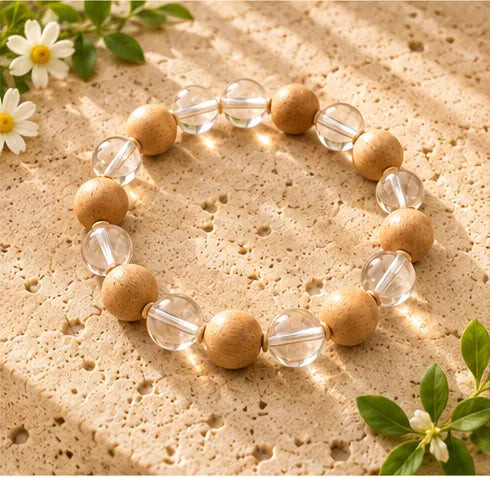
Seen close, a wooden bead and a clear one approach light in opposite ways. The wood holds it on its surface. A transparent quartz bead lets you see through it, even while reflections seem to move inside. Set side by side, they create a rhythm that is more tactile than an arrangement of identical stones.
Colorless transparent quartz is commonly called rock crystal. Quartz itself is silicon dioxide, SiO₂. In a polished bead, the material becomes an elegant counterpoint to the fine, irregular marks of woodgrain. [1][2] The bracelet’s design does not require gold spacers, charms, or elaborate symbols. Its conversation happens between two materials.
There is a difference between a bead of sandalwood and sandalwood paste or oil. Grinding fragrant wood for paste, burning wood as incense, extracting oil, and wearing a polished bead are different forms of use. A bracelet should not borrow the effects or meanings of those other forms as if they were automatically transferred to a wrist. Its connection is one of material and personal association.
For INDIELIXIRS®, this piece suggests calm, clarity, and presence as intentions. “Calm” is the choice to slow a moment; “clarity” is taking a second look; “presence” is being where your body already is. These are ways to approach the bracelet, not outcomes it guarantees.
Chandan in India: a gesture of reverence
For many people in India, chandan is first encountered not as jewellery, but as sandal paste in a temple or home ritual. The gesture may be very small: the preparation of paste, the touch of it, the attention given to offering or adornment. Its meaning belongs to the people practising and the traditions in which they learned it.
A specific example is better than a claim about “all Indian religion.” Sri Sringeri Sharada Peetham describes its image of Sri Janardana, a form of Vishnu, as covered with sandal paste throughout the year. In that setting, chandan is part of a living devotional practice. It is not a generic sign that all sandalwood objects have been blessed or possess the same religious status. [3]
When the material appears in an everyday bracelet, it meets another world: a morning commute, a meeting, a coffee with someone you love. A person of faith may associate it with a remembered practice. Someone else may appreciate the grain and muted tone. A bracelet can make room for both without claiming to perform a religious ceremony on its own.
INDIA
Paste, offering, devotion.
One living temple practice, among many distinct traditions.Japan: fragrance, craft, and the art of attention
In Japan, fragrant woods entered another cultural history. Kyoto National Museum describes how incense customs accompanied Buddhism to Japan and how, by the Muromachi period, the appreciation of individual pieces of incense wood became part of cultivated practice. The utensils for storing and using fragrant woods could themselves be works of art. [4]
One museum object brings this history into focus. A Kamakura-period incense container holds an image of Kannon, the bodhisattva of compassion. The museum notes that sandalwood’s fragrance would have been released when the container opened for worship. Here, material, craftsmanship, scent, and devotion meet in a very particular object. [5]
This is not a Japanese precedent for an INDIELIXIRS® bracelet, nor a claim that touching our beads recreates the experience of incense. It offers another way to notice how human beings have valued fragrant wood: not only for what it smells like, but for the deliberate moment created around it.
JAPAN
Fragrant wood, craft & incense.
WESTERN AUSTRALIA
Land, stewardship & distinct species.
HAWAIʻI
ʻIliahi, kapa & a complex trade history.
Western Australia: a different sandalwood, a different history
“Sandalwood” is a family of related stories, not one tree from one country. Western Australia’s native sandalwood, Santalum spicatum, has its own botanical identity and the long histories of Aboriginal peoples who knew and used it. The Western Australian Forest Products Commission describes Aboriginal use of the resource for thousands of years, including as a food source, and its present work with Traditional Owners. [6]
That is a story of knowledge, care, land, and stewardship. It deserves to be heard on its own terms. We should not turn it into a vague statement that any bracelet “contains Aboriginal wisdom,” and we are making no claim that this bracelet uses Australian sandalwood. The cultural breadth matters precisely because the differences matter.
Hawaiʻi: ʻiliahi, fragrance, and the cost of trade
In Hawaiʻi, native sandalwoods are known as ʻiliahi. The University of Hawaiʻi’s Hawaiian language dictionary records that sandalwood was used to perfume kapa, a traditional barkcloth, in powdered form or mixed with coconut oil. [7] This is another distinct use of a fragrant wood, involving textile and everyday cultural life rather than an Indian paste or a Japanese incense container.
The history also carries a warning about extraction. A University of Hawaiʻi plant resource describes the hardship connected to the large export trade in ʻiliahi to China from the late eighteenth into the nineteenth century. A beautiful material can have a difficult history when demand outruns care for the people and places from which it comes. [8]
That observation should make a contemporary brand more attentive to language and sourcing. We are not assigning Hawaiʻi’s history to this bracelet or claiming its beads are Hawaiian. We are allowing the wider history of sandalwood to complicate a simple romance about “ancient wood.”
What travels, and what stays local
Across these four settings, sandalwood can be paste, incense wood, a plant valued by its custodians, or a fragrance for cloth. The name covers different botanical species and different relationships between material and people. The common thread is sensory attention: grain, touch, aroma, craft. That is an interpretation drawn from the examples, not a single universal meaning handed down by all cultures.
Our bracelet is much smaller than any of those histories. It is a contemporary object of wood and crystal that invites a personal response. We do not need to pretend it has been consecrated in India, carved in Japan, harvested in Australia, or made from ʻiliahi to appreciate what reading these histories can teach us about material and attention.
Crystal: the clear interval
Rock crystal has its own long life in human craft, but the most immediate reason for placing it beside chandan is visual. A transparent bead makes the next wooden bead look warmer. The wood gives the quartz a surface against which its openness becomes visible. Neither has to “amplify” the other in a scientific or energetic sense to make the design compelling. [1][2]
Touch each kind of bead with a thumb. The polished quartz may feel cooler at first; the wood gives a different texture beneath the finger. Such a shift can become a private prompt to take one breath before answering a message or walking into a room. The action is yours. The materials make it easy to remember.
The phrase “Ancient calm. Modern clarity.” captures the contrast, as long as we understand it as poetry about design and intention. History does not certify calm, and a transparent mineral does not confer clear judgment. A considered object can still be a wonderful companion to a considered habit.
AN AROMATIC COMPANION
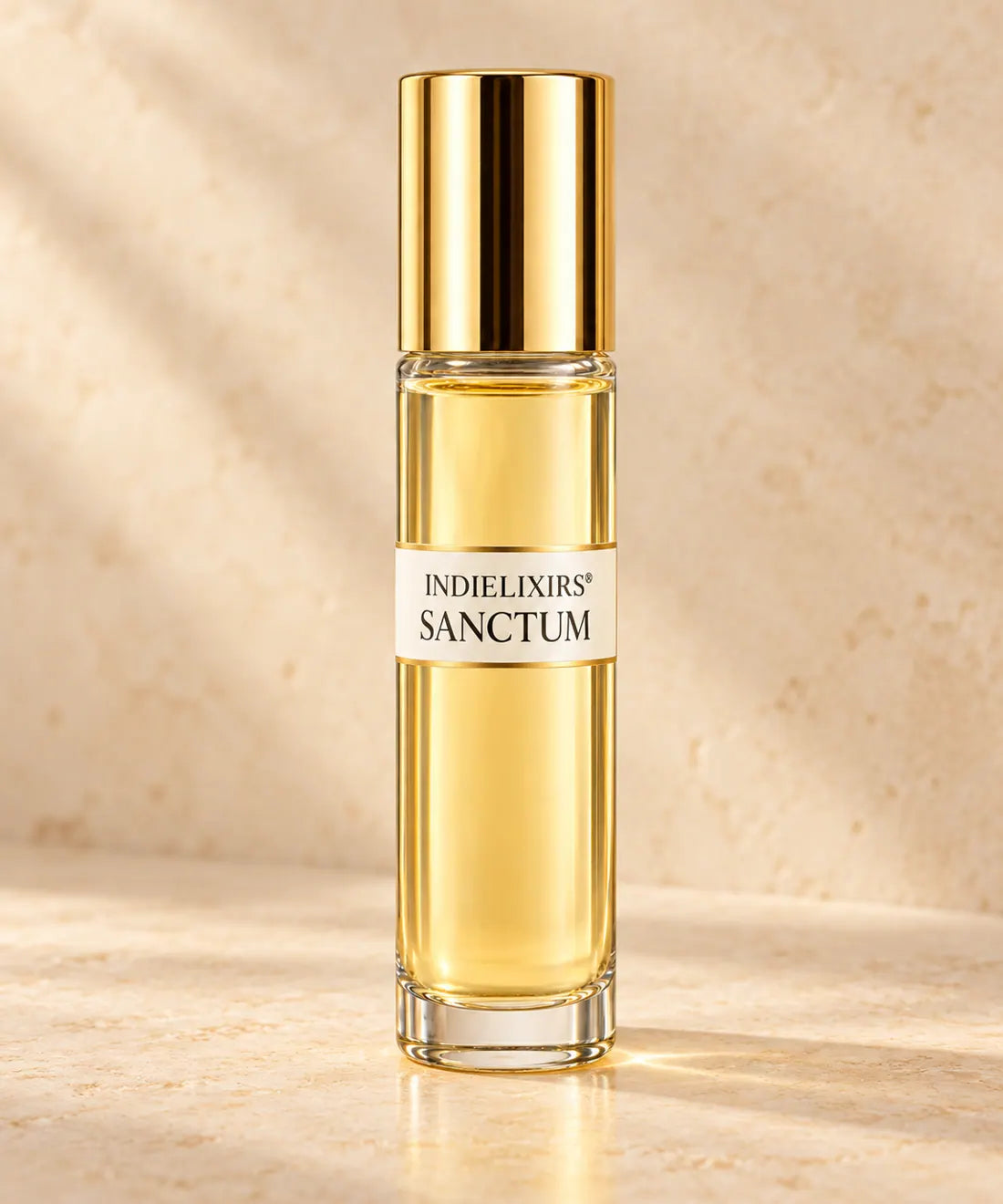
Meet SANCTUM.
A separate roll-on oil. A moment on the skin. A bracelet worn after.
Meet SANCTUM: the aromatic companion
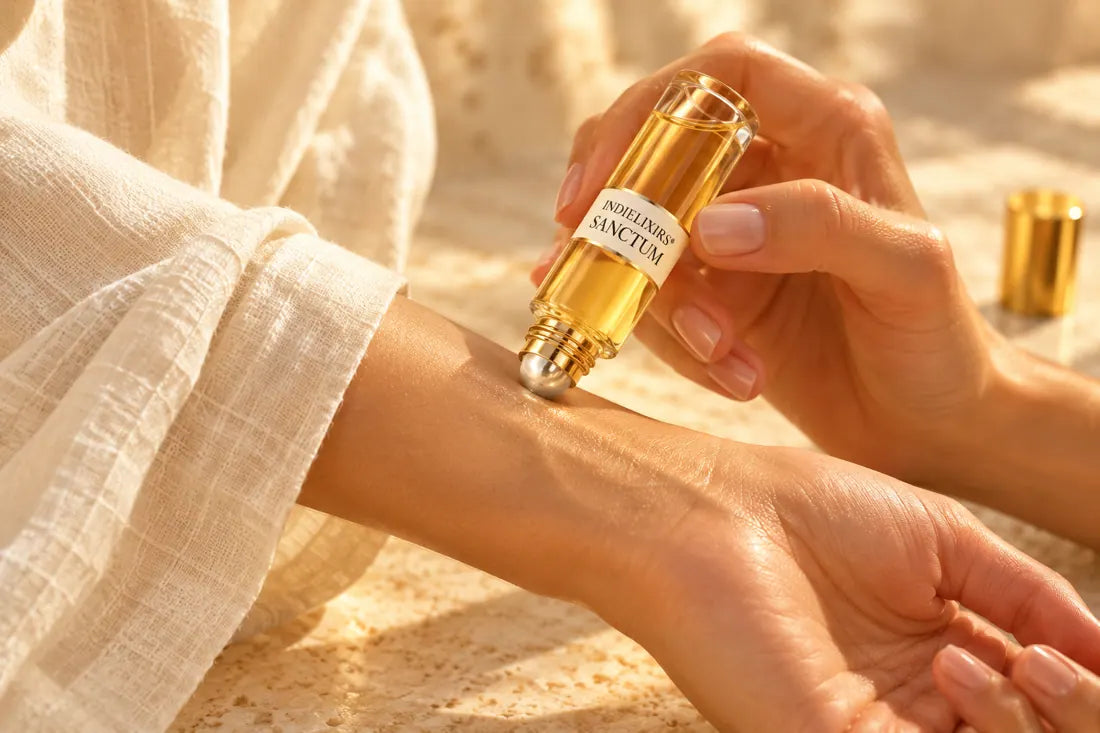
INDIELIXIRS® SANCTUM is a separate aromatic roll-on oil, not an ingredient in the bracelet. The bottle belongs visibly in this story: a close-up of its simple label, a second image of the roller touching the inner wrist, and the Chandan Crystal Bracelet nearby as the object worn after the moment. A reader should know at a glance what SANCTUM is and how the two products can fit into one routine.
If you enjoy fragrance, follow SANCTUM’s label and skin-safety directions and roll it onto a pulse point on your skin. Pause to notice the aroma. Then wear or hold the bracelet. Keep the oil off the chandan beads, quartz beads, and elastic. Wood and stringing are best kept dry; the scent and the bracelet can share a ritual without touching one another.
The sequence is deliberately simple: roll, pause, wear. It is not a prescription, a religious rite, or a guarantee of calm. A scent may become associated with a chosen pause through repetition, while the bracelet becomes a visible cue to remember it. The meaning comes from what you choose to practise.
THE SMALL RITUALRoll. Pause. Wear.
Two separate objects, one considered moment.
A minute you can take anywhere
You need neither a perfect morning nor a silent room. Try this in the middle of a real day:
Feel. Notice one wooden bead against your finger, or the bracelet resting on your wrist. Let your shoulders settle if that feels comfortable.
Look. Follow a reflection through one clear bead. Notice where your attention wandered. There is no requirement to empty your mind.
Choose. Ask, “What would make the next minute more considered?” It might be listening, replying with care, stepping outside, or simply finishing the task in front of you.
Meditation and mindfulness can take many forms, including focusing on breath, sound, or a visual image; the U.S. National Center for Complementary and Integrative Health describes mindfulness as awareness of the present without judgment. This little routine is our editorial suggestion for using a bracelet as a cue. It does not turn the bracelet or the oil into a clinical treatment. [9]
Worn, gifted, and lived with
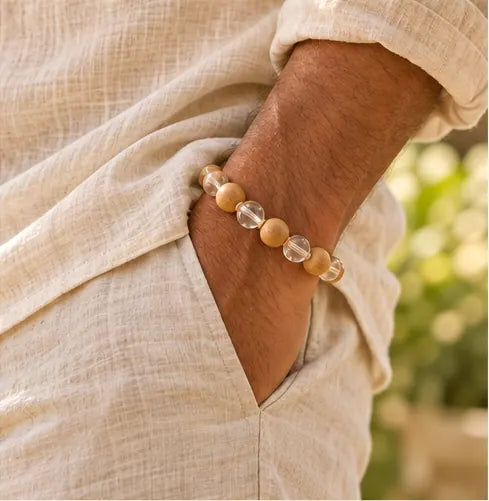
Against cream and linen, the bracelet looks almost tonal. Against black, navy, or deep green, its clear beads catch points of light and the wood feels warmer. It can sit alongside a watch or on its own. It can feel devotional to one person, contemporary to another, and simply elegant to someone who cares nothing for ritual language.
As a gift, it carries a sentence that can be made personal. To a partner: “I thought you would wear this often.” To a son or daughter: “Take a little space for yourself as you begin.” To a parent: “This is for the moments that belong to you.” The recipient need not inherit your interpretation. A good gift leaves them room to create their own.
The simplicity is a strength. No elaborate chart is required to understand the colours. The wood and the quartz are visible, tactile, and wearable. Their story can stay with you without needing to announce itself to everyone else.
Care for wood and crystal
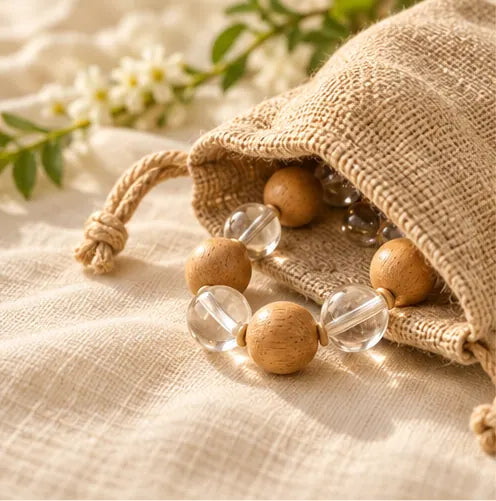
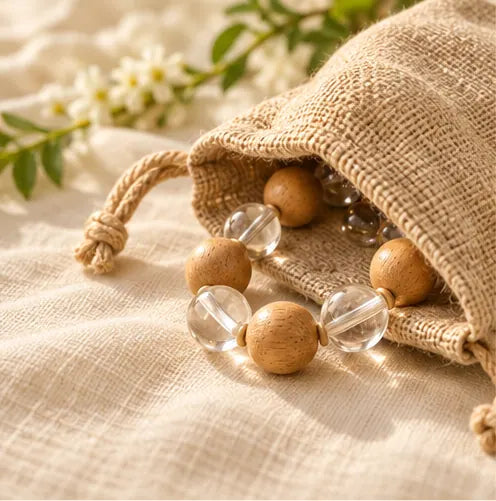
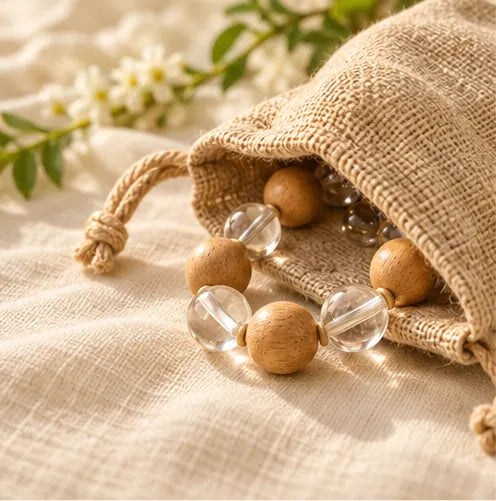
Keep this bracelet dry. Avoid perfume, oils, harsh cleaners, prolonged water exposure, and heat. Roll it over the hand rather than stretching the elastic sharply; wipe the beads gently with a soft, dry cloth and store it in its pouch apart from sharp jewellery. Do not oil the wooden beads. These are ordinary care steps for a strung object containing wood, not a spiritual cleansing procedure.
A wood bead may vary subtly in grain or tone, and clear quartz can look different under different lighting. We describe the intended materials and their appearance; this Journal article is not a batch certificate, botanical identification, or lab report for an individual bead.
The quiet in your hands
The world does not become quiet because a bracelet touches your wrist. A busy day remains a busy day. But a human being can notice the grain of a bead, see light cross a clear stone, remember a personal intention, and give the next moment a little more care.
From an Indian gesture of sandal paste to Japanese incense craft, from Australian stewardship to Hawaiian kapa, sandalwood’s wider histories remind us how much meaning people can place in material. The Chandan Crystal Bracelet does not claim those histories as its own. It meets you in the present: warm wood, clear stone, and room for a choice.
THE PIECE BEHIND THE STORYChandan
Chandan
& Crystal
Warm grain. Clear light. Room for a moment of your own.
EXPLORE THE BRACELET ↗Sources and further reading
[1] Gemological Institute of America — Amethyst: A Variety of Quartz. Names colorless quartz “rock crystal.”
[2] U.S. Geological Survey — Quartz. Quartz is silicon dioxide.
[3] Sri Sringeri Sharada Peetham — Sri Janardana. Sandal paste in a specific living temple practice.
[4] Kyoto National Museum — The Aesthetic Pleasures of Incense. Incense and fragrant wood in Japanese cultural history.
[5] Kyoto National Museum — Seated Senju Kannon in an incense container. Sandalwood scent and devotional craft.
[6] Government of Western Australia, Forest Products Commission — Sandalwood. Santalum spicatum, Aboriginal use and stewardship.
[7] University of Hawaiʻi, Wehewehe Hawaiian Language Dictionaries — ʻiliahi. Perfuming kapa with sandalwood.
[8] University of Hawaiʻi, Native Plants Hawaiʻi — Santalum ellipticum. Cultural context and nineteenth-century export history.
[9] U.S. National Center for Complementary and Integrative Health — Meditation and Mindfulness. Types of attentional practice and limits of the evidence.
Editorial note
This article draws on mineralogical references, practitioner accounts, museum collections, government materials, university resources, and public-health research from different regions; direct source links appear above. Each source speaks to its own subject and does not endorse INDIELIXIRS®, its affiliates, employees, or products. The cultural and historical descriptions are offered for general interest, not as personal advice or as claims about the origin, species, scent, or tested composition of any particular INDIELIXIRS® bracelet. Our styling, symbolic interpretation, reflection exercise, and proposed SANCTUM pairing are INDIELIXIRS® editorial ideas. Neither the bracelet nor the oil promises a medical, emotional, or spiritual outcome. Visuals in the preview are art-direction mockups and should be checked against final product photography before publication.