

Cart
0
THE INDIELIXIRS® JOURNAL / ISSUE 01Three stones.
Three stones.
One direction.
Why pyrite, citrine and green aventurine belong together—and what we choose to make of them.
A VISUAL STORY OF STYLE, SYMBOLISM & AMBITIONSCROLL TO EXPLORE
EDITORIAL VISUALISATION
SEE CLEARLYBEGIN BOLDLYCONTINUE PATIENTLY
THE MOMENT BEFORE YOU MOVE
There is a moment before almost every meaningful change when nothing has changed yet.
You are still in the same job, but you have begun imagining the work you really want to do. The business remains a plan in a notebook. You have not made the difficult call, negotiated the fee, applied for the course, or taken the first step toward financial independence. From the outside, it looks like an ordinary day. Inside, a direction is forming.
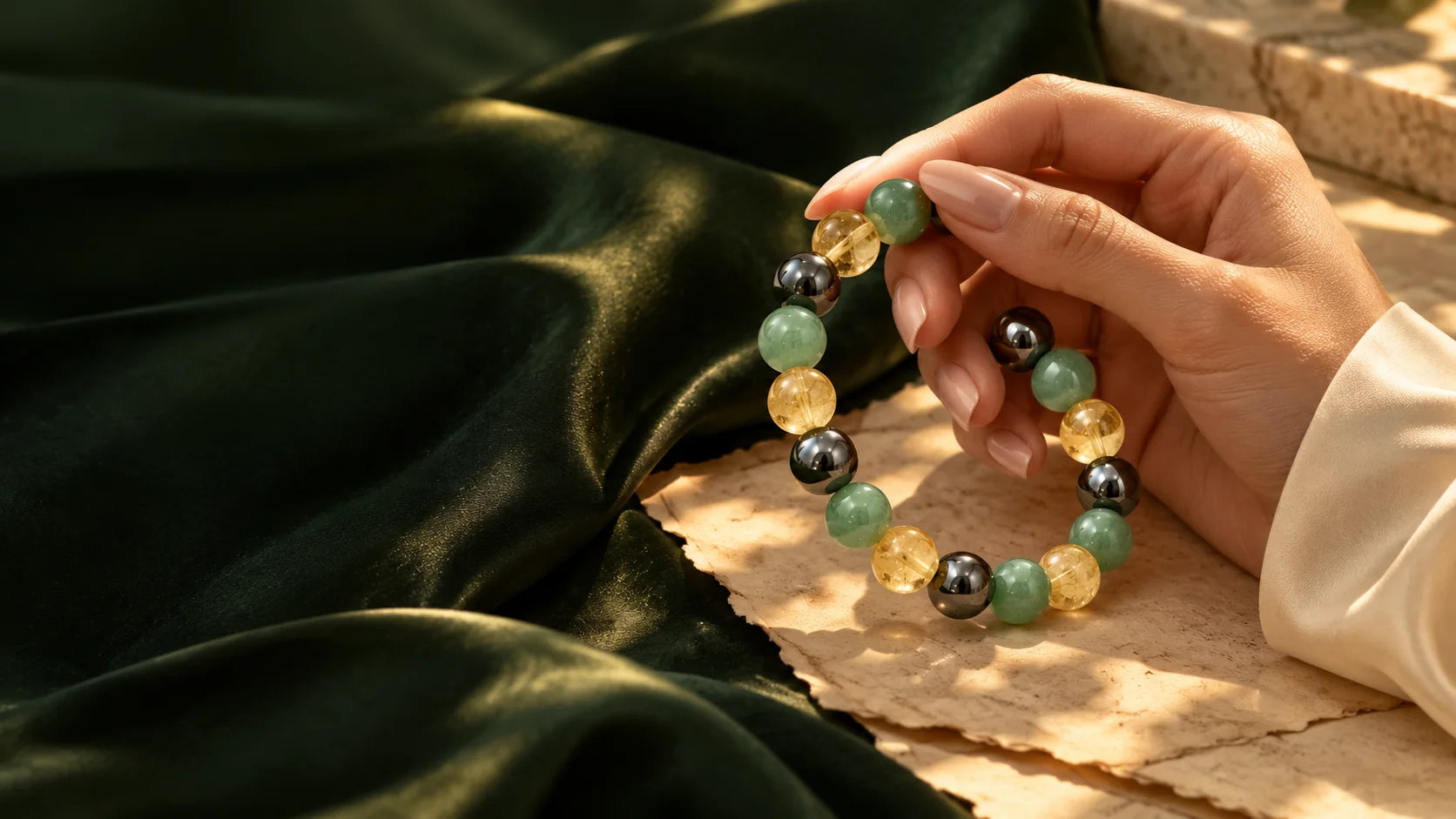
That is the moment we had in mind when we brought together pyrite, citrine and green aventurine for the INDIELIXIRS® Wealth Bracelet.
The three stones do not share a single origin, texture or colour. Pyrite brings a cool, metallic presence; citrine a measured warmth; green aventurine an earthy, living green. They also offer three distinct ideas to carry into an ambitious life: see clearly, begin boldly, and continue patiently.
These ideas are our interpretation of the combination. The mineral facts are facts; the meanings we give the stones are human choices. No stone can promise an income, a promotion or a favourable turn of events. But an object worn with intention can invite a useful question each time we notice it: What will I do today that moves me in the direction I have chosen?
✧
First, look closely.
Before asking a stone what it means, it is worth asking what it is.
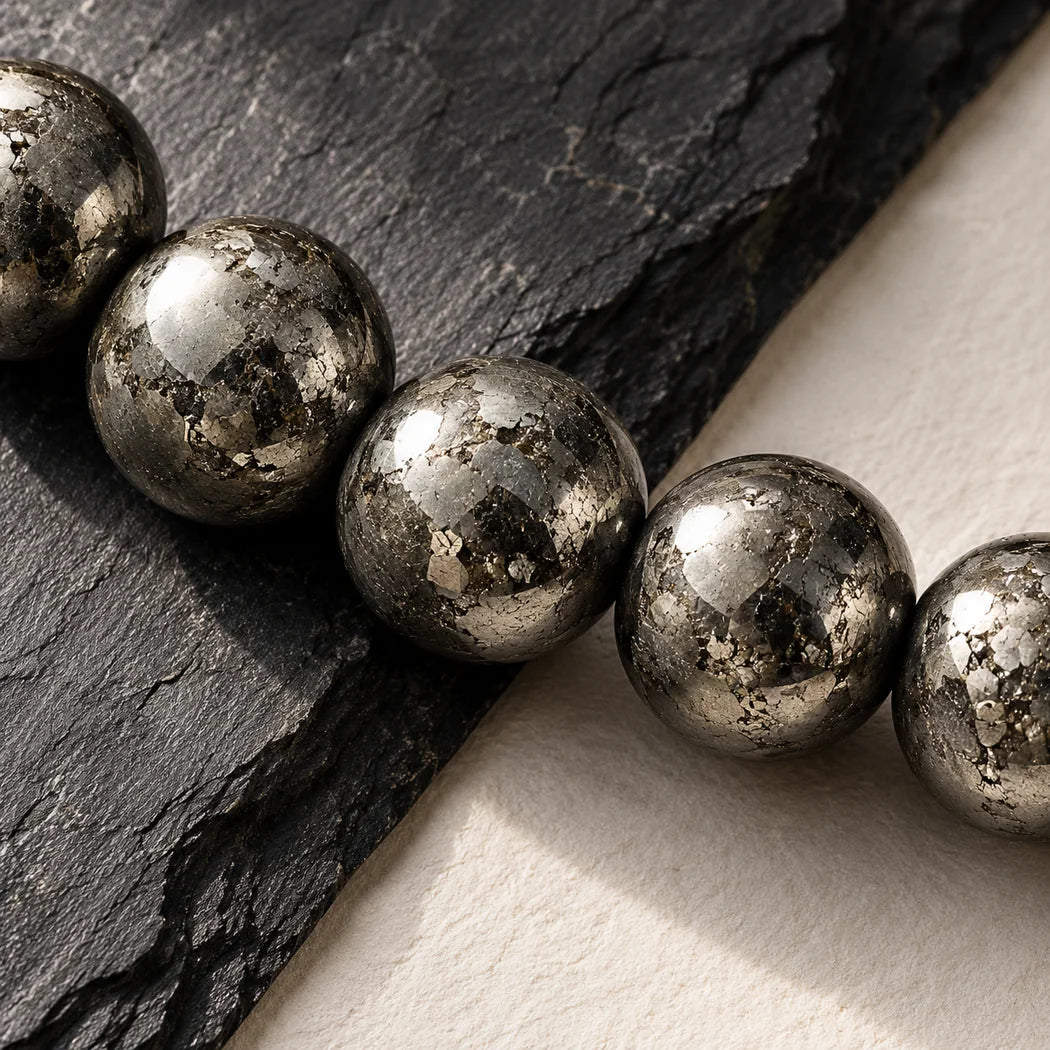
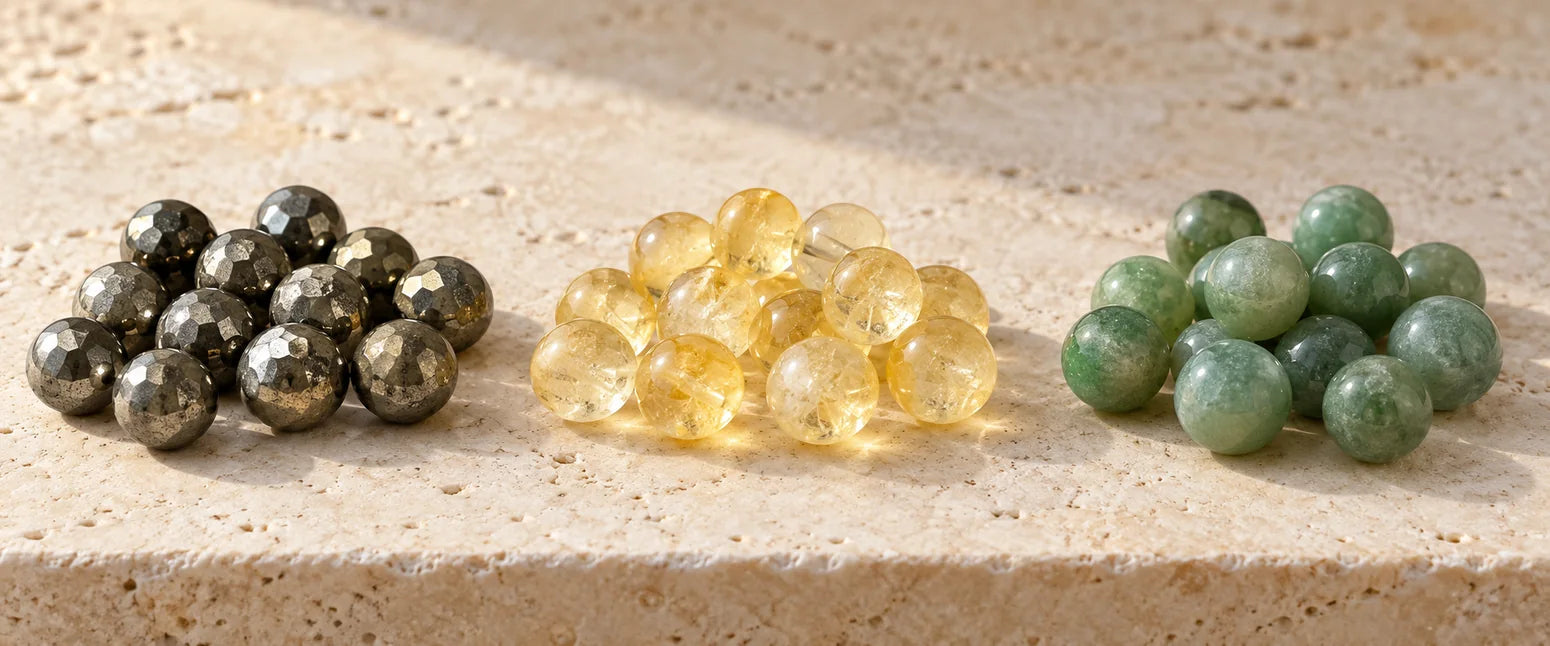
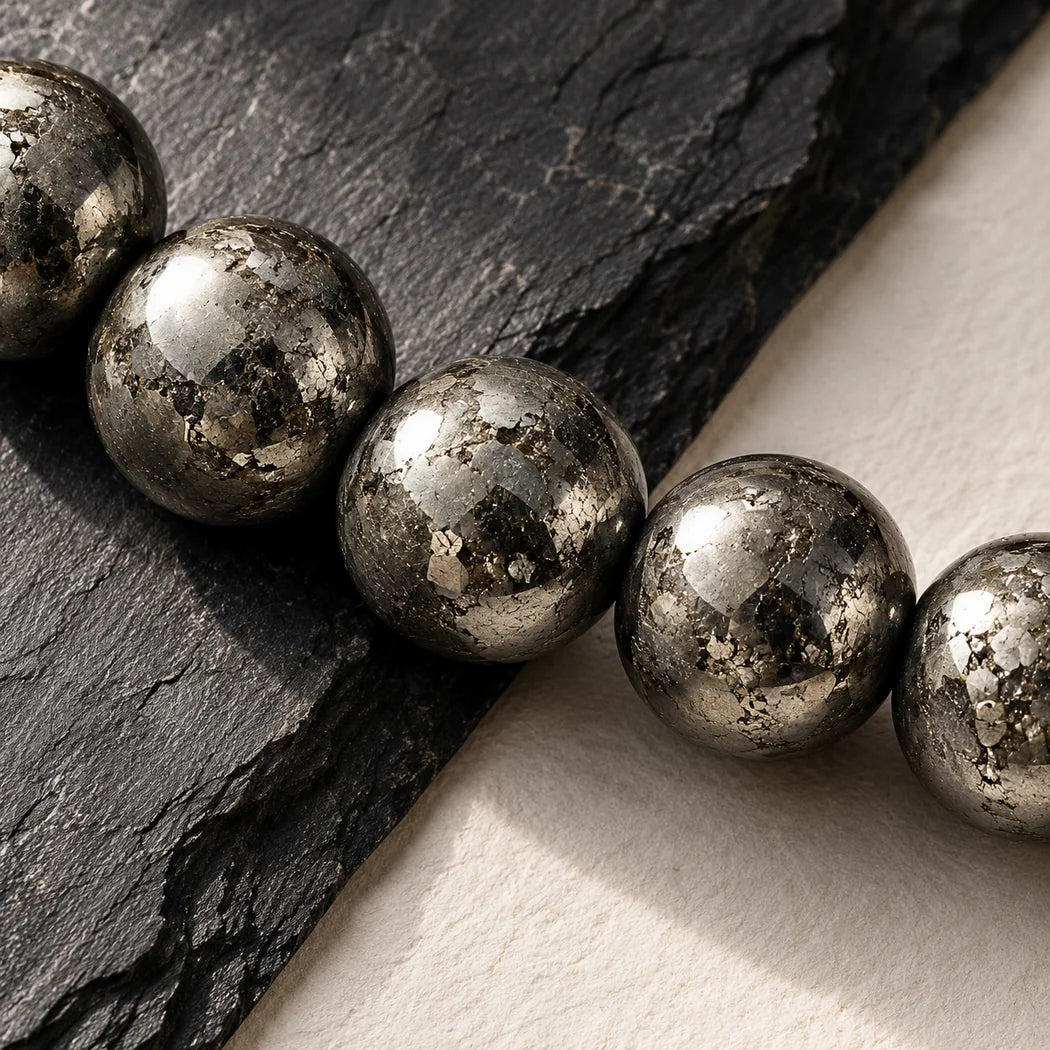
Pyrite is iron disulfide, a mineral made of iron and sulfur. In its natural crystal form it can have a striking metallic lustre and often grows in sharply defined geometric shapes. Its resemblance to gold gave it the familiar nickname “fool’s gold.” The name says more about the human eye than about pyrite: a surface can resemble something valuable without being that thing. The pyrite beads in the INDIELIXIRS® bracelet should be understood visually as metallic grey, with a cool sheen, rather than painted or described as golden beads. [1, 2]
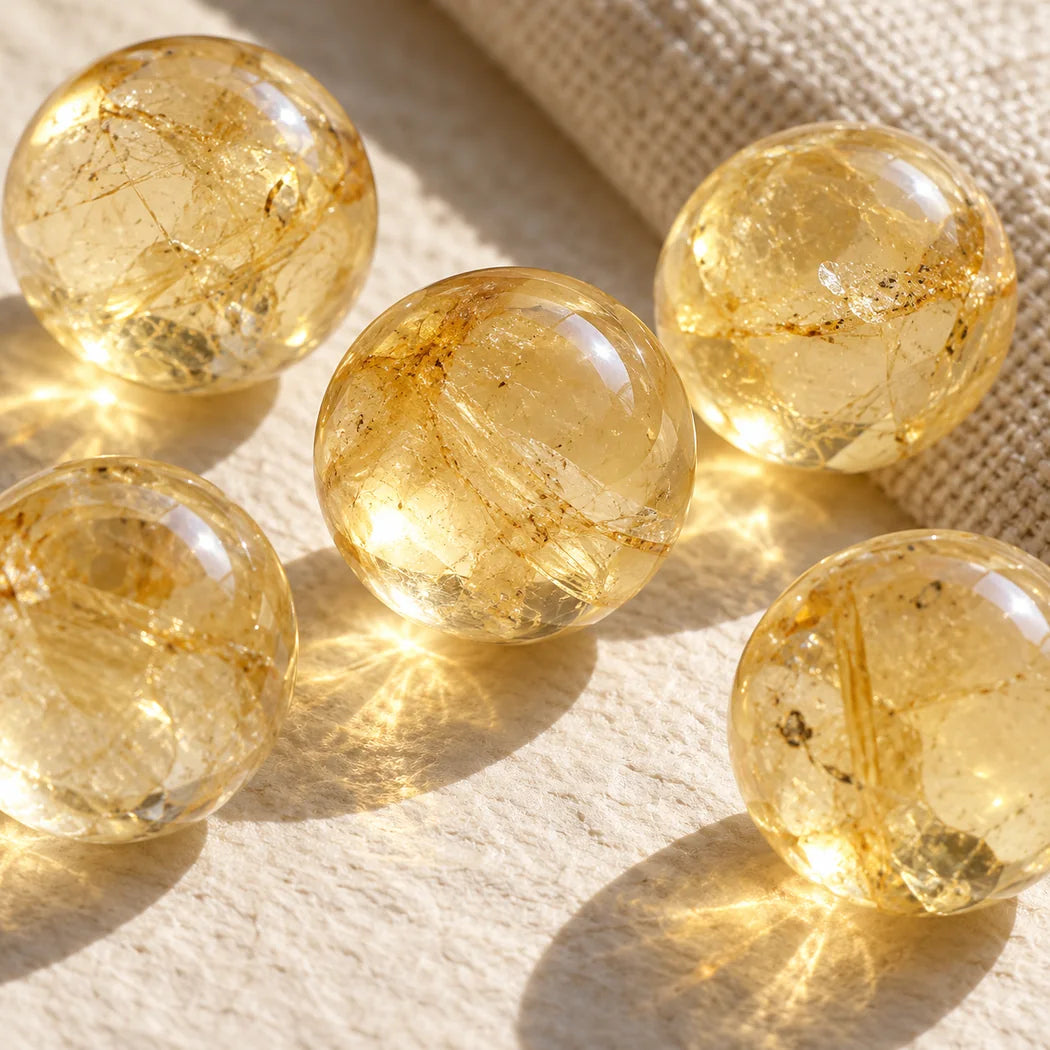
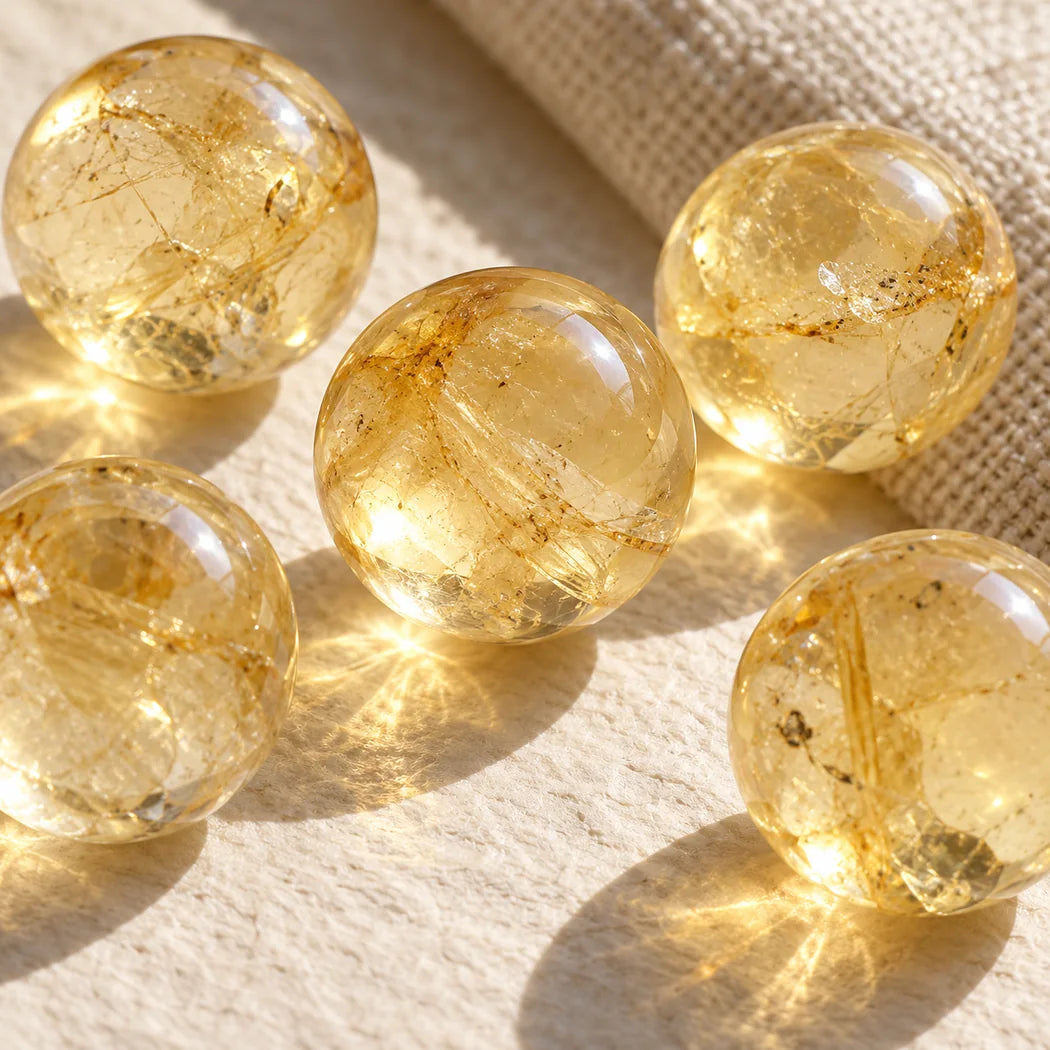
Citrine is the yellow-to-orange variety of quartz. Its colour can range from a light, almost lemon yellow through deeper amber and brownish orange. Traces of iron are involved in that colour. In the INDIELIXIRS® bracelet, we are drawn to its gentle yellow warmth: a quiet point of light between the cool grey of pyrite and the green of aventurine. [3]
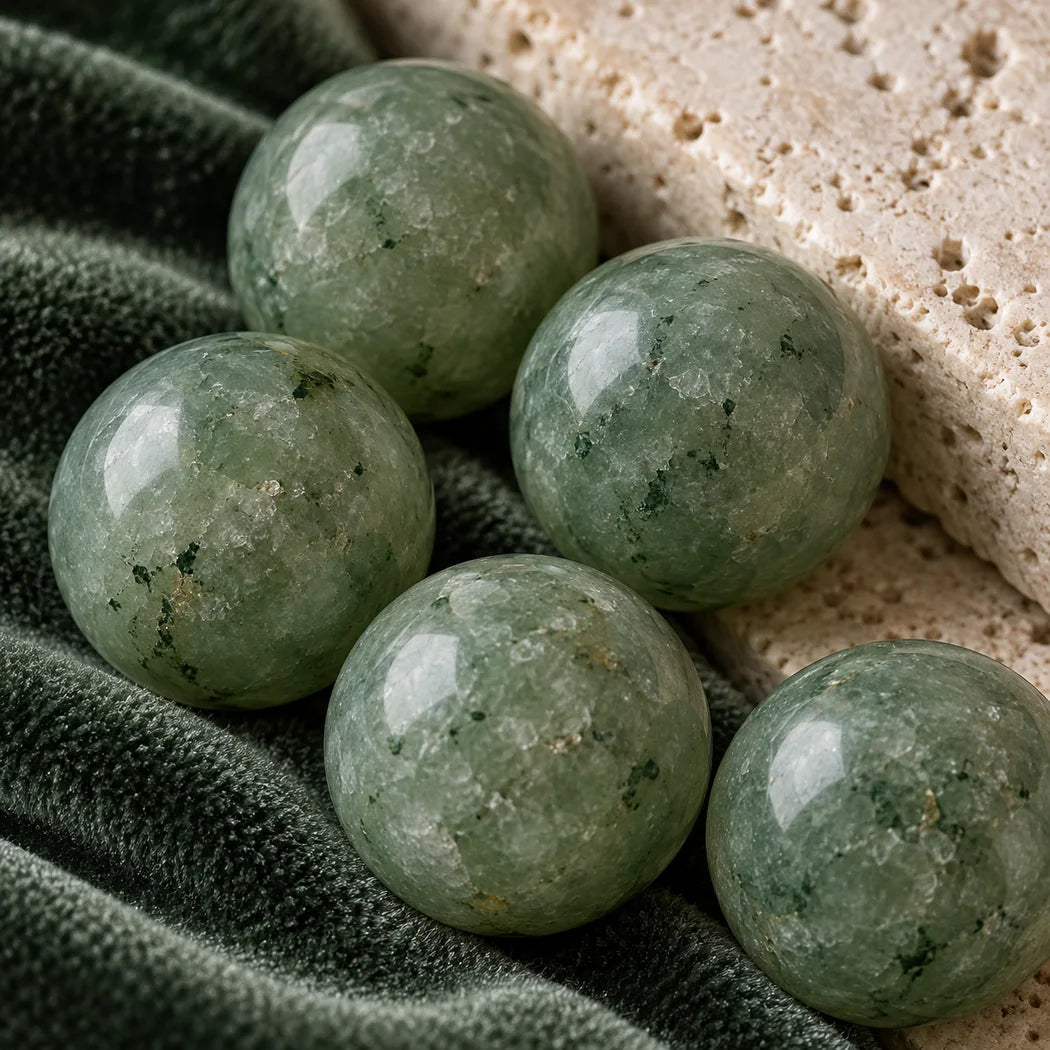
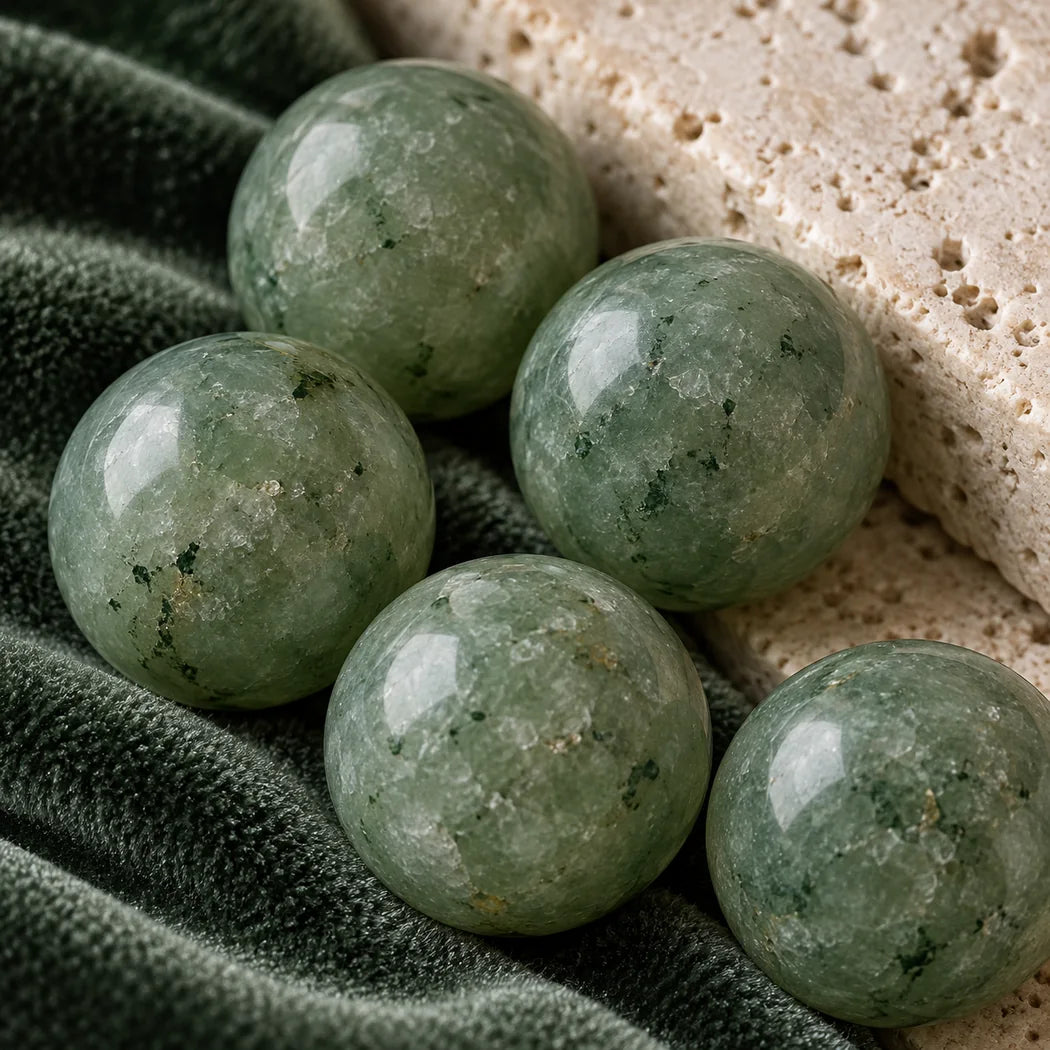
Green aventurine is a variety of quartz material whose green appearance and soft internal shimmer can come from tiny mica inclusions, often fuchsite. Gemologists call that spangled optical effect aventurescence. Some beads show it clearly in the light; others read as a quieter, more even green. It is not emerald, and it need not pretend to be. Part of its appeal is precisely that it looks like itself. [4, 5]
Set side by side, these are also a study in contrast. A reflective mineral; a translucent yellow quartz; a green quartz with a subtle inner texture. The bracelet is appealing before anyone tells a story about it. It can finish a linen shirt, sit against a dark sleeve, or add an unexpected detail to workwear. Meaning matters, but beauty is allowed to matter too.
STONE 01 / METALLIC GREY
Pyrite.
The discipline of seeing what is there.
Pyrite's nickname gives us an unusually honest place to begin a conversation about wealth.
“Fool’s gold” is often treated as a joke about being mistaken. We prefer to hear a more useful warning in it: before you pursue something, look at it carefully. What seems like an opportunity may be one; it may also be a distraction dressed in persuasive language. A high return may hide a high risk. A prestigious title may come with no space to grow. A busy calendar can resemble progress while leaving important work untouched.
Pyrite becomes, for us, a symbol of discernment: the ability to examine the offer, read the details, ask a second question and separate appearance from substance. That symbolic reading comes from its visual resemblance to gold; it is not a claim that the mineral sharpens judgement.
Discernment is not pessimism. It lets ambition become more precise. Consider the difference between saying “I want to be successful” and asking:
- What kind of work would I be proud to do well?
- What would I need to learn before accepting this opportunity?
- Is this expense an investment in my future, or a way to look successful today?
- Whose advice is informed, and whose certainty is merely loud?
There is strength in being willing to ask those questions, especially when everybody else seems to be moving quickly. Pyrite's metallic presence gives that pause a visual language: composed, unsentimental, ready to look again.
The mineral has its own fascinating history beyond the metaphor. Pyrite can form distinct crystals and has been used to make sparks when struck against another hard material; its name is associated with fire. A bead on the wrist does none of that work for you. But its long mineral story reminds us that a material can have more than the one meaning suggested by its nickname. [6]
STONE 02 / GENTLE YELLOW
Citrine.
Giving an idea permission to begin.
If pyrite invites a closer look, citrine brings light into the composition.
The yellow of citrine can suggest the first clear hour of a morning: a desk before the messages begin, a page before the first sentence, a conversation before either person knows where it will lead. Across modern crystal practices, citrine is often linked with confidence, optimism and abundance. Those are associations held by people, not effects established by gemology.
For INDIELIXIRS®, citrine stands for initiative. There is a point at which preparation can become another form of delay. You have revised the proposal enough. You have imagined every possible objection. You know the first email will not be perfect. Send it thoughtfully anyway.
Initiative need not be loud. It may look like registering a company, setting aside the first small sum of savings, or asking a mentor for twenty minutes. It may be a woman returning to work after years of caring for others, or a student deciding to learn a skill that will take several years to master. Each is a genuine beginning, even when nobody applauds it.
The physical stone has a beauty of its own. Citrine's yellow is a colour we can see and enjoy; the courage to begin is a meaning we bring to it. One need not mistake the two to feel the warmth of both. [3]
STONE 03 / MUTED GREEN
Aventurine.
Room for a future to grow.
Green is often used as shorthand for growth. But growth itself is rarely tidy.
A venture can take longer than expected. Skill develops unevenly. Some months bring visible results; others are spent strengthening the roots: learning accounts, improving a product, repairing trust, resting enough to begin again. The polished surface of a green aventurine bead can contain minute flecks that catch light at different angles. To us, it is an apt image for progress that reveals itself gradually. The flecks are a mineral feature; the interpretation is ours. [4]
In contemporary crystal language, green aventurine is frequently called a stone of opportunity or luck. We would put that idea differently. Opportunities are easier to recognise when you have kept yourself ready for them. Luck may play a part in life, but preparation, relationships and persistence give chance somewhere to land.
Green aventurine therefore represents continuity in this bracelet. Make the second attempt. Keep the appointment. Learn what the first launch taught you. Revise your budget. Follow up respectfully. Let a modest gain become a foundation rather than a reason to stop.
It also asks a gentler question: What am I growing for? More money can mean greater security, freedom to choose work, the ability to support family, or the means to create something of value for others. An ambition becomes more durable when it has a reason larger than a number.

A DEEPER QUESTIONWhat is
What is
wealth?
Resources matter. So do the choices we make with them, the work we value, and the life they help us build.
THE STORY CONTINUES BELOW ↓Wealth is more than money.
Money still matters.
It is easy to say that true wealth is peace, love, or health. There is truth in each. But it would be careless to use that language to dismiss the importance of money to someone paying rent, building a business, educating a child or caring for a parent.
Financial resources matter. So do the skills to earn, protect and use them. Wealth can also include time you have some control over, work that does not erode your dignity, relationships in which help can be given and received, and the ability to make a decision without constant fear.
The aim is not to pretend these forms of wealth are interchangeable. A kind friend cannot pay every bill; a large bank balance cannot create every form of belonging. It is to ask what a full life needs and to pursue resources with a clear sense of their purpose.
This question appears in different traditions, though those traditions do not give identical answers. In the Bhagavad Gita, the well-known teaching at 2.47 turns attention toward action while warning against fixation on its results. Read in its own context, it is a spiritual teaching, not a formula for business success. Yet it offers a bracing reflection for an ambitious person: do the work within your power, while recognising that outcomes involve more than your will. [7]
An early Buddhist discourse on household life speaks in unusually practical terms about initiative at work, guarding what one has earned, good friendship and balanced finances. Buddhist teachings also place livelihood within an ethical path. These are teachings with their own aims and context, not endorsements of a gemstone bracelet. They do show that the question “How should I earn and live?” deserves more thought than “How can I get more?” [8, 9]
The Qur'an's discussion of wealth in 28:77 holds worldly provision together with doing good and avoiding corruption. This is a verse within a particular religious account, not a general-purpose prosperity slogan. Placed beside the other traditions, it offers another reason to ask what our resources make possible for other people as well as ourselves. [10]
We bring these perspectives into the Journal with respect for their differences. None of these texts assigns a spiritual power to pyrite, citrine or green aventurine. Their value here is in deepening the human conversation around ambition: effort, ethics, gratitude, restraint and responsibility.
“An intention is a beginning.THE INDIELIXIRS® JOURNAL
Action gives it a shape.”

MAKE IT YOURS / 03Wear it.
Wear it.
Then move.
An intention can be specific without being narrow. “I want wealth” may be emotionally powerful, but it is difficult to act on. “I will understand my expenses this month,” “I will ask for the fee my work merits,” or “I will devote two evenings a week to the skill my next role requires” gives the mind somewhere to begin.
A simple daily practice might look like this:
- Name the direction. In a sentence, write what you are working toward and why it matters.
- Name the next action. Choose something you can actually do today or schedule this week.
- Name the boundary. Decide what you will decline, postpone or examine more carefully so that the intention has room.
- Return and revise. At week's end, look at what happened. Keep what worked; change what did not.
You may wear the bracelet while doing this, place it beside your notebook, or notice it before an important conversation. The stone does not perform the action. The ritual gives you a moment to remember it. If you do not connect with rituals, the bracelet can simply be something beautiful to wear; it does not demand a belief system from its owner.
This distinction matters. A meaningful object can help you articulate a commitment. It cannot replace a financial plan, a difficult conversation, professional advice, or the repeated work that follows a decision. We think there is more dignity in saying that plainly than in promising a miracle.

WORN IN REAL LIFEA direction
A direction
you can carry.
At the desk, on the way to a meeting, or in the middle of an ordinary day. A piece of personal style with a meaning chosen by its wearer.
Why bring the three together?
One stone alone could suggest one idea. Together, these three create a more complete conversation.
Pyrite asks: Am I seeing clearly? Citrine asks: Am I willing to begin? Green aventurine asks: Can I continue with care?
There are days when one question matters more than the others. A person considering an investment may need pyrite's pause. A person waiting for perfect certainty may need citrine's encouragement. Someone disappointed by a slow season may need the green stone's patience. The bracelet does not know which day you are having. You do.
The combination also has a visual rhythm. Cool metallic grey keeps the warmth of yellow from becoming too sweet. Yellow makes the green feel brighter. Green gives the metal a softer place to rest. Nothing needs a large charm or a gold spacer to announce what the bracelet means. Its materials and proportions can speak quietly.
That quietness is part of its usefulness as a gift. You might give it to a daughter about to begin her first job, a husband building something after hours, a son entering a demanding new chapter, or a friend who is finding the courage to start again. The accompanying message can be personal: I see what you are working toward. I am with you as you build it.
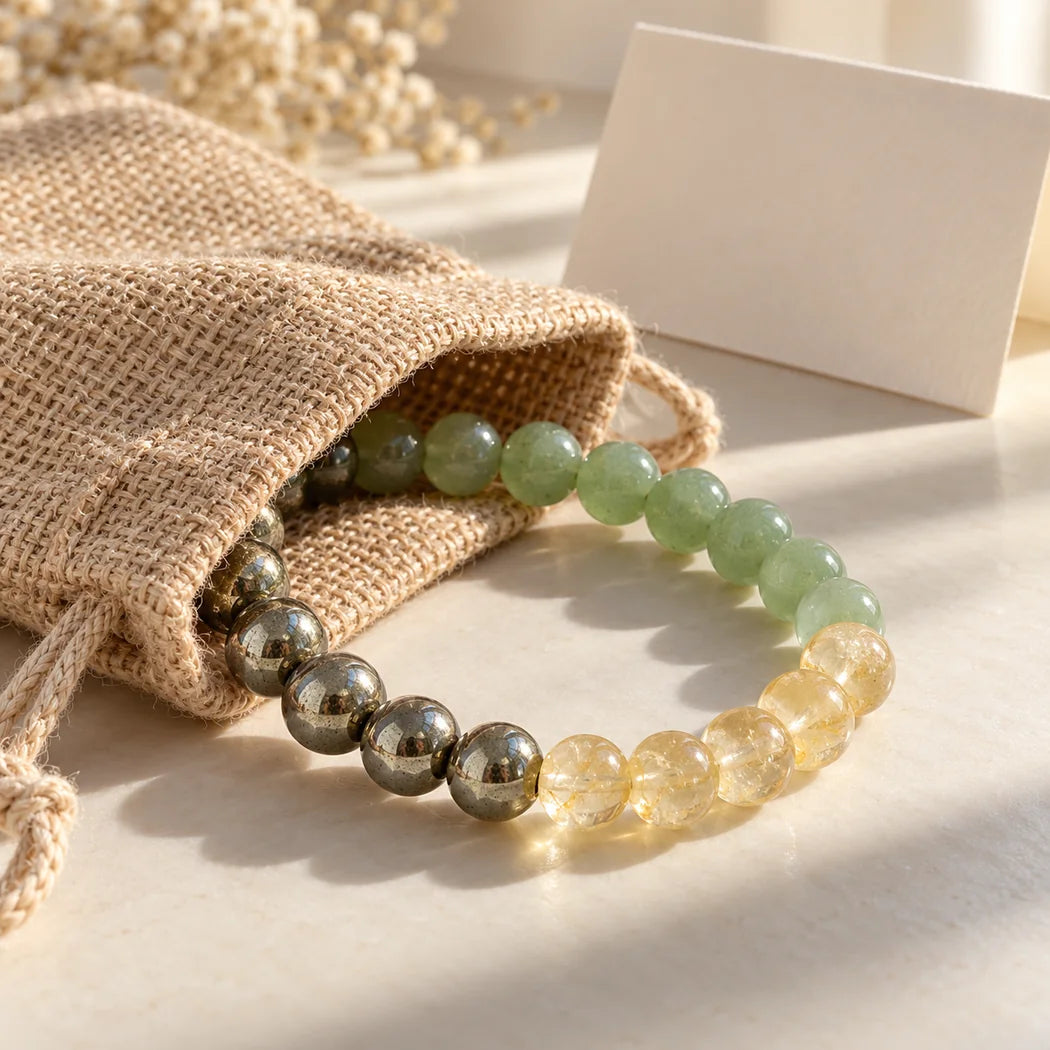
A THOUGHTFUL GIFTFor someone
For someone
becoming.
A gift for the next chapter: the new role, the first business, the return after a pause, or the plan that has finally become possible.
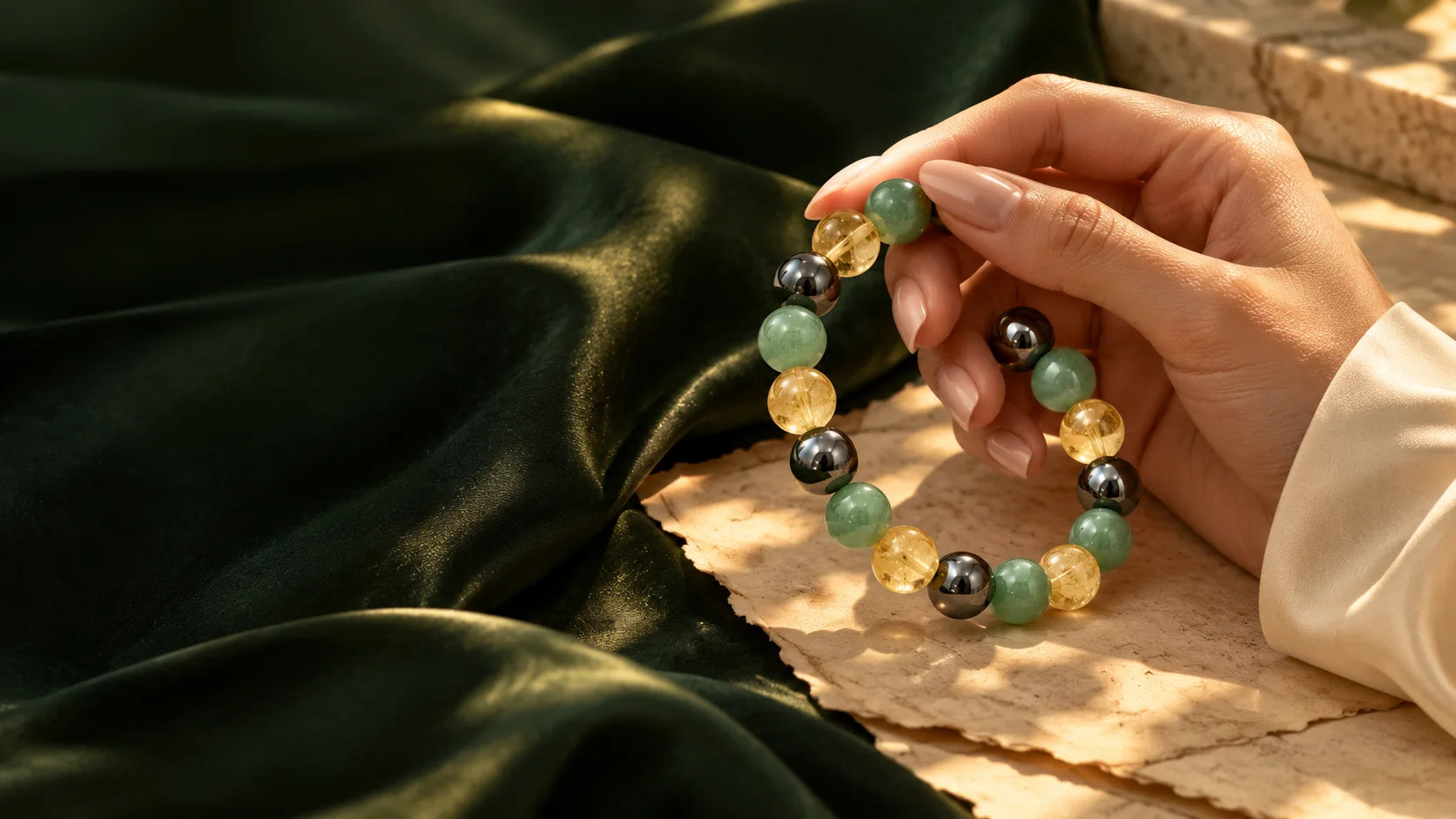
THE MOMENT BEFORE YOU MOVESee clearly.
See clearly.
Begin.
Keep going.
Three stones, one quiet reminder of the direction you have chosen.
A FEW HONEST QUESTIONS
Wearing & care.
Which wrist should I wear it on?
There is no mineralogical reason a Wealth Bracelet must be worn on a particular wrist. If a personal practice gives one side meaning for you, follow it. Otherwise, choose the side that is comfortable and less likely to catch against your desk or daily work.
Do the stones need to be “activated”?
Some people enjoy a short moment of reflection before wearing symbolic jewellery. You can name your intention if that feels meaningful. No activation is required for the bracelet to be wearable or beautiful, and no ritual can guarantee an external result.
How should I care for it?
Wipe the beads gently with a soft, dry cloth. Keep the bracelet away from prolonged soaking, harsh cleaners, perfume and oils, and do not stretch the elastic unnecessarily. Store it separately when you are not wearing it. Because this is a mixed-material piece, a dry, gentle routine is the simplest default. Do not apply INDIELIXIRS® SANCTUM directly to these beads or the elastic; use the roller only as directed on skin or pulse points.
Will wearing it bring me money?
No object can make that promise honestly. If the bracelet helps you pause, remember what matters and take a better next step, its meaning may become very real to you. Your results will depend on circumstances and the work you do, not on a guaranteed property of a stone.
A FINAL THOUGHT
At some point you will close this page and return to your own day. There may be a decision waiting, an idea you have delayed, an expense to review, or a conversation you have been avoiding. The three stones offer no shortcut past it.
They offer a way to mark the moment before it: see clearly, begin, keep going.
That is why we chose pyrite, citrine and green aventurine. That is what Wealth, with intention means to us.
The bracelet is what you wear. What you build is up to you.
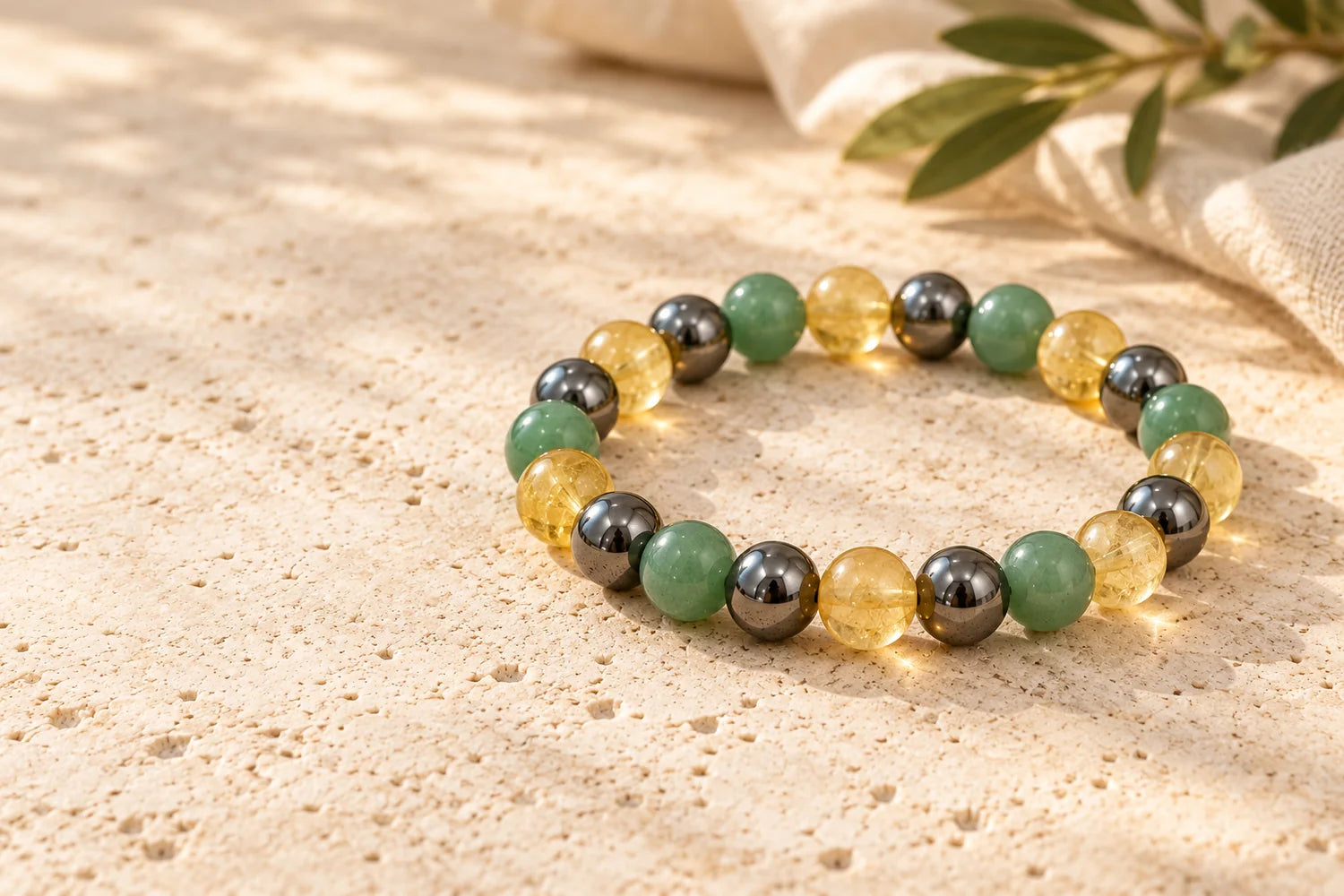
EXPLORE THE PIECEWealth,
Wealth,
with intention.
Pyrite, citrine and green aventurine in a bracelet that looks considered and carries a meaning you make your own.
EXPLORE THE WEALTH BRACELET ↗PYRITE · CITRINE · GREEN AVENTURINEAbout this story
This article draws on mineralogical references, religious texts and contemporary interpretations from different traditions; links to the sources are included below. The externally sourced information and interpretations are presented for general interest and do not represent personal advice or endorsements by INDIELIXIRS®, its affiliates or employees. Descriptions of the bracelet’s design and INDIELIXIRS®’s chosen symbolism are the brand’s own editorial perspective. Neither the article nor the bracelet guarantees health or financial outcomes.
Sources and further reading
Editorial sources and reading
The interpretations of the three stones and the suggested ritual are INDIELIXIRS® editorial ideas. The sources below support the mineral descriptions and the religious passages specifically identified above; they do not establish prosperity or healing effects for the bracelet.
- U.S. Geological Survey, “Pyrite, also known as ‘fool's gold’” — composition.
- U.S. Geological Survey, “What is ‘Fool's Gold?’” — pyrite and mistaken identity.
- Gemological Institute of America, Citrine overview — quartz, colour and iron.
- GIA, “Optical Effects of Phenomenal Cabochons” — mica spangles in aventurine quartz.
- GIA, “Polymer-Impregnated Aventurine Quartz” — fuchsite inclusions in identified aventurine quartz.
- University of Minnesota, Common Minerals: Pyrite — crystal character, sparks and name.
- IIT Kanpur, Gita Supersite, Bhagavad Gita 2.47 — various translations and commentaries.
- SuttaCentral, AN 8.75 — initiative, protection, friendship and balanced finances.
- SuttaCentral, SN 45.8 — right livelihood within the Noble Eightfold Path.
- Qur'an 28:77 — provision, good conduct and avoiding corruption.
ART DIRECTION V3 · PREVIEW ONLY